The synthesis gap UK practices can't bill for
· SF Admin
Three to five hours of multi-entity reconciliation per client per quarter, billed inside the same fixed fee. Why MTD ITSA broke the practice model — and what's missing from the tech stack.
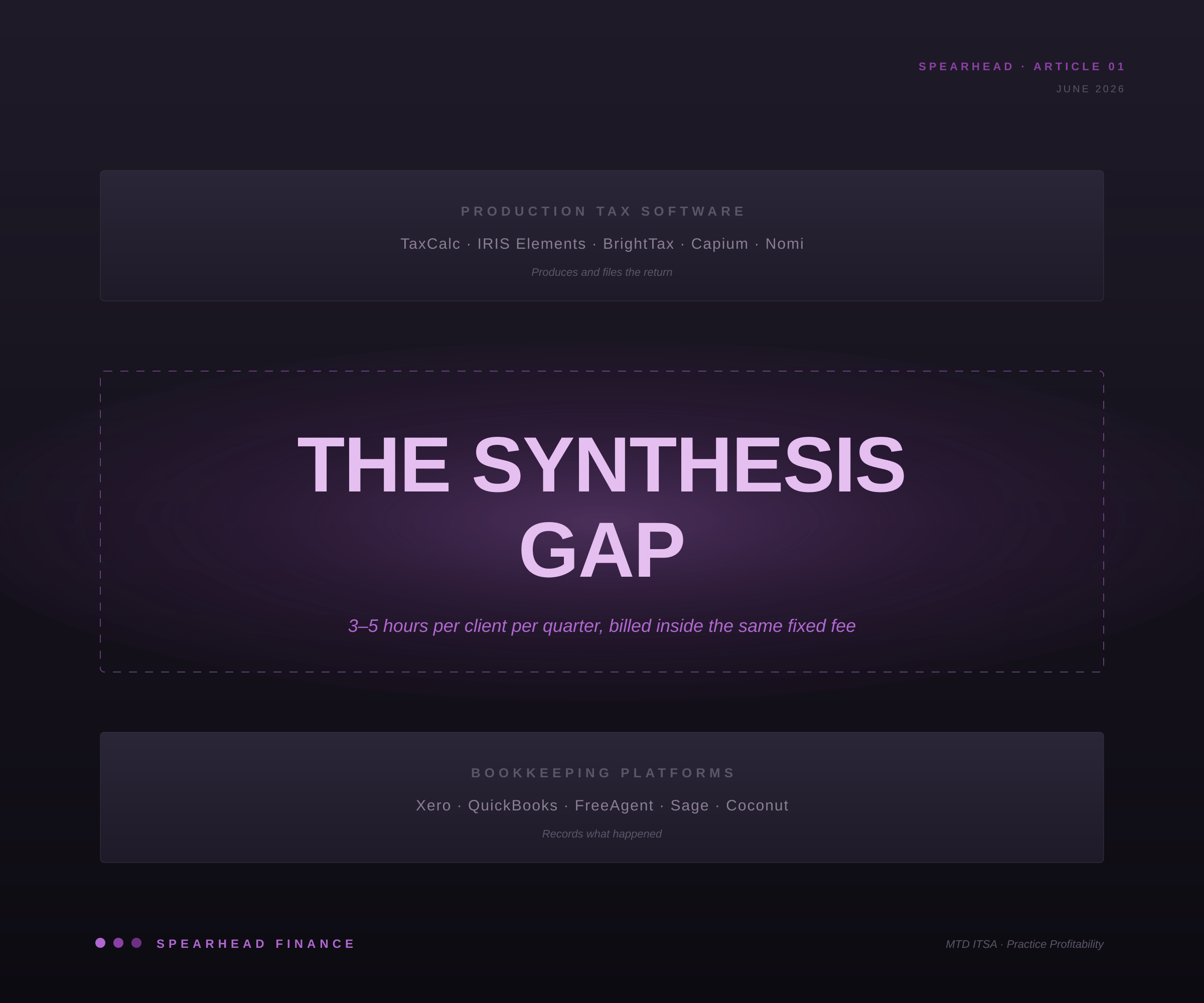
It's the second week of August 2026. Your firm has just submitted its first batch of MTD ITSA quarterly updates for £50,000-plus clients. The deadline is past. The team is exhausted. And you're staring at last quarter's revenue trying to work out why margins on multi-entity clients fell off a cliff. You know roughly why. You're doing more submissions, and more reconciliation. The fixed fees you agreed in February — when MTD ITSA still felt like next year's problem — assumed an annual workflow. They didn't assume four submissions a year per client, plus a final declaration. They didn't assume the multi-entity work that turned out to be the bulk of the time spent. This article is about that work. Not the submissions — the submissions are the surface metric. The bulk of the time is in something HMRC didn't account for and the trade press hasn't named. It's the synthesis gap. The 5x is real, but it's the wrong metric HMRC's published estimate is that MTD ITSA increases practice workload by approximately 5x per qualifying client. That figure is submissions in to submissions out: where you used to file one SA100 per year, you now file four quarterly updates plus a final declaration. Five touchpoints where there was one. Across the 864,000 taxpayers mandated in the first wave — growing to 2.92 million by April 2028 — the trade press has been quoting the 5x as if it were the headline number. In practice — meaning in your practice — the 5x is real, but it's the wrong number to track. The submissions themselves are largely automated by the time they reach HMRC. Xero submits. QuickBooks submits. FreeAgent submits. TaxCalc, IRIS Elements, BrightTax, Capium, Nomi — they all submit. None of them generated the work that justified the fee. The work is upstream of submission. It's reconciliation. And it has grown not 5x but somewhere between 3x and 7x depending on the complexity of your client mix, because each quarterly submission requires you to take a position on what's actually happened across each of your client's entities. On the increasingly common multi-entity client, "what's actually happened" lives in four or five places that don't talk to each other. That work has a name. It is the synthesis gap. The synthesis gap, defined The synthesis gap is the work between the bookkeeping layer and the production tax layer. Bookkeeping platforms — Xero, QuickBooks, FreeAgent, Sage, Zoho, Coconut — record what happened, entity by entity. They are very good at this. The bank feed pulls. The categorisation engine fires. The VAT return populates. The quarterly MTD ITSA submission pushes to HMRC. As of April 2026, every major bookkeeping platform handles single-entity MTD ITSA submissions competently. Production tax software — TaxCalc, IRIS Elements, BrightTax, Capium, Nomi, Sage tax — produces and files the actual returns. They are very good at this. The SA100 generates. The CT600 generates. The final declaration goes in. Every major production tax tool handles per-entity return production competently. What neither does, and what no incumbent has yet built, is the synthesis. Taking those two things — what happened across multiple entities, and what's owed across multiple positions — and rolling them up into a coherent tax outcome for a single beneficial owner. That synthesis is what your team does in Excel between Tuesday and Friday of the deadline week. A worked example: Sarah, contractor Take a client your firm probably has several variants of: Sarah, contractor, mid-five-figure income, multi-entity. Sarah's tax position lives across multiple intersecting records: Her personal Self Assessment — salary from her Ltd Co, dividends received, savings interest, occasional capital gains Her trading Limited Company — corporation tax, payroll, director loan account, dividend declarations An IR35-tagged contract running through the Ltd — deemed payment computation, status reasoning Her property SPV — a single buy-to-let in a separate Ltd, with its own CT return, rental income, mortgage interest Director loan and benefit-in-kind position — straddling personal and corporate Five different records. None of which, in the incumbent tool stack, talk to each other. Xero or QuickBooks: each entity is its own organisation file. Sarah has at least two bookkeeping subscriptions running (one for the operating Ltd, one for the SPV). Her personal SA data lives in spreadsheets your team curates from bank statements. TaxCalc, IRIS or BrightTax: each entity is its own return. SA100 for personal. CT600 for the operating Ltd. Separate CT600 for the SPV. Separate dividend computations. Separate IR35 working papers. The synthesis — the answer to "what is Sarah's tax position?" — is a manual exercise. Your manager (or, more often, your senior, billed at a lower charge-out rate to protect margin) reconciles: Dividends declared from Ltd against dividends reported on Sarah's personal SA IR35 deemed payment against Sarah's personal income tax computation SPV transactions against Sarah's personal capital gains tracking Director loan account movements against benefit-in-kind position Companies House confirmation statement against PSC position That reconciliation takes three to five hours per client per quarter. Across a 50-client book of multi-entity contractors, that is 150 to 250 hours per quarter of work that wasn't in your fee quote. The fixed-fee math Run the numbers against your fixed-fee model. A Sarah-type client pays your firm somewhere between £150 and £250 per month — call it £200. That's £2,400 a year. At a 30% practice margin (generous for a mid-size firm in 2026), £720 of that is profit. The rest is delivery cost. Pre-MTD ITSA, the £2,400 covered: an SA100, a set of Ltd accounts and CT600, dividend computations, a PSC confirmation, a phone call or two during the year. Maybe 15 hours of senior time annually. That's £160 per hour fully loaded. That works. Post-MTD ITSA, the same fee covers: four quarterly updates, a final declaration, all the synthesis reconciliation between them, and still the year-end set of accounts and Ltd work. Add 12 to 20 hours of reconciliation per year per client — three to five hours, four times a year. You are now at 27 to 35 hours of senior time on the same £2,400 fee. That's £69 to £89 per hour fully loaded. You can absorb that on a few clients. You can't absorb it across your book. And re-pricing every multi-entity client mid-year is the kind of conversation that ends partnerships. Why the existing stack doesn't solve it The reflex response from the trade press has been: use better tools. The implicit message is that there is a tool that bridges the gap. There isn't. Bookkeeping platforms don't bridge the gap because they're not architected to. Xero's data model is per-organisation, not per-beneficial-owner. Their March 2026 partnership with Anthropic — JAX, the AI agent that can now submit MTD updates — is a real piece of work, but it operates inside the Xero data model. JAX submits Sarah's Ltd update from Sarah's Ltd file. It does not synthesise across her personal SA, her dividends, her IR35 contract, and her SPV. That work is structurally invisible to it. Production tax software doesn't bridge the gap because it isn't architected to either. TaxCalc, IRIS Elements, BrightTax, Capium and Nomi all produce returns per entity. They have done since the 1990s. Even the cloud-native ones (Capium, Nomi) sell on a per-seat or per-module basis to practices, not on a beneficial-owner basis. The data model is the same as the desktop tools before them. The synthesis is a feature request, not a product. Practice operations tools — Karbon, TaxDome, AccountancyManager, Senta — manage workflow but don't touch tax data. The synthesis happens in Excel. What actually solves it: the synthesis layer There is a layer missing in the practice tech stack. It sits above bookkeeping and beside production tax. Its job is the synthesis — holding a multi-entity beneficial-owner tax position, ingesting from bookkeeping platforms, producing the supervised draft that production tax can submit, maintaining the audit trail across the quarterly cycle. This is the layer this firm, Spearhead Finance, has been building. It's called TaxSync. We are not the only people who will eventually build it — the gap is now too obvious. What we have discovered in eighteen months of building is that the data-model rebuild is genuinely hard, and incumbents who have optimised around per-entity records for thirty years can't retrofit it quickly. There is a window of probably eighteen to twenty-four months before the gap is filled by something. Practices that integrate a synthesis layer in that window protect their margins. Practices that wait absorb the synthesis work indefinitely. For practices in the next 18 months If you're running a small or mid-size practice — between ten and five hundred MTD ITSA clients on the book — there is a programme worth knowing about. The TaxSync Practice Tier sells per-client, not per-seat. That matters because your existing tax software vendor probably charges per seat, and a per-client model lets you recover the synthesis time without re-pricing your clients. The wholesale rate is £15 to £25 per client per month depending on book size, with a £150 monthly minimum and a 12-month commitment. The cost is designed to embed inside your existing fixed fee — so your client sees no bill change, but you recover three to five hours per client per quarter back to senior time you can redeploy. The synthesis gap won't show up on your P&L this quarter. It will show up in the second half of the year, when senior hours are exhausted, juniors have done too much technical work too quickly, and the book that looked profitable in March is breaking even by October. If that is what your numbers are starting to tell you, it isn't your team. It's the gap.