Your tax position is one thing, not four
· SF Admin
Sarah pays her accountant £4,800 a year. About a third of that is reconciliation work — turning five separate entity records into the one tax position she thought she was paying for in the first place.
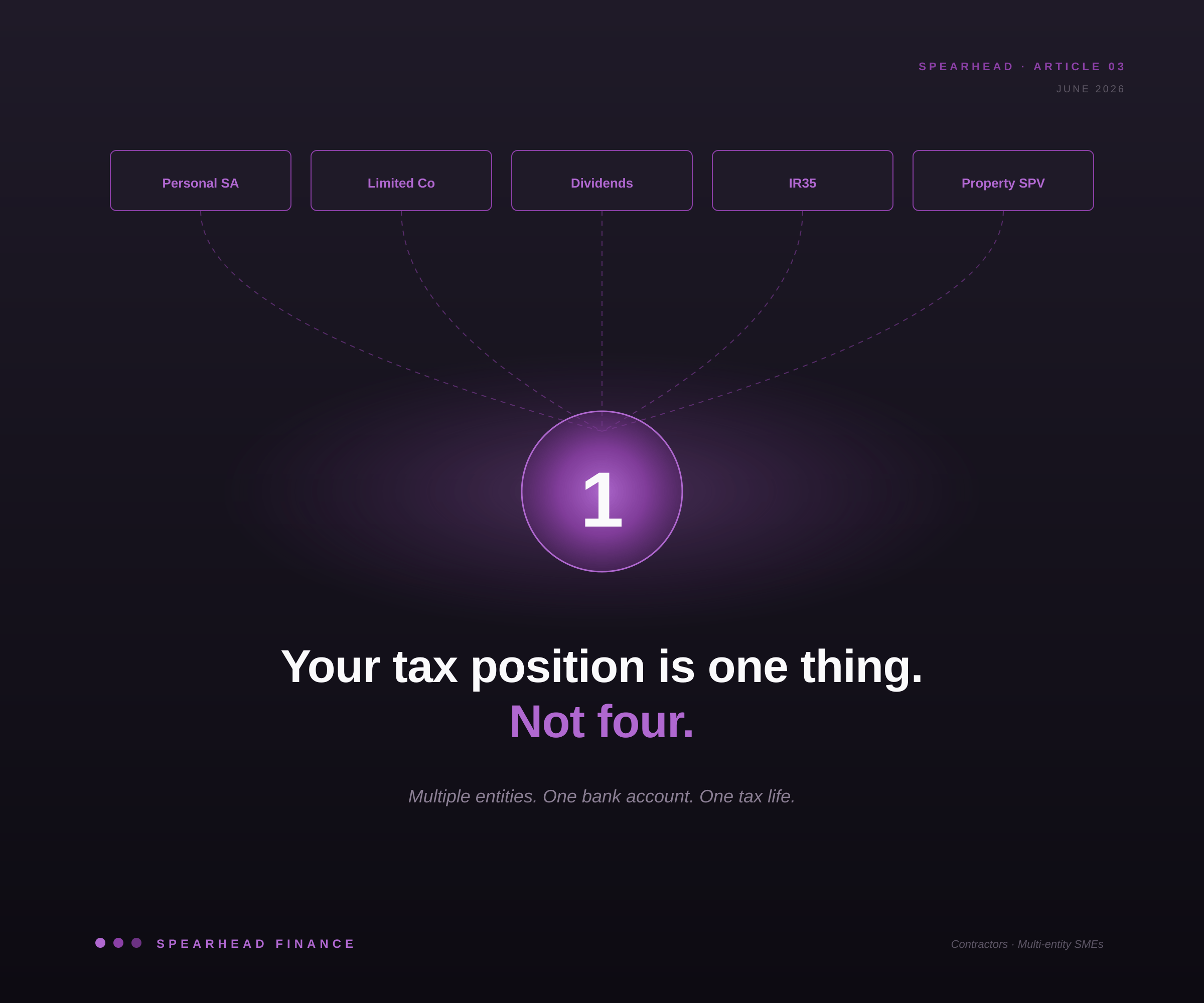
Sarah is a software contractor earning £140,000 a year. Limited company. Salary plus dividends. One inside-IR35 contract she keeps because the client is good, even though it costs her on tax. A buy-to-let in Manchester she bought two years ago, sitting in a separate property SPV. To Sarah, this is one financial life. One business. One bank account she checks on Friday afternoons. To her accountant, Sarah is five separate tax records. Last year, Sarah paid her accountant £4,800. She doesn't begrudge the fee — she likes her accountant, the firm is good, the work gets done. But it has crept up year on year, and she has the increasingly uncomfortable feeling that most of what she's paying for isn't tax advice. It's reconciliation. It's her accountant taking five separate things and turning them into one tax position. Which is what she thought a tax position was in the first place. She's not wrong. The five "you"s the system sees If you're a contractor or SME founder making real money in the UK in 2026, your "one financial life" almost certainly looks something like this: 1. Your personal Self Assessment. Salary from your limited company, dividends, savings interest, occasional capital gains, maybe a side income you've been meaning to declare properly. 2. Your trading limited company. Corporation tax, payroll, director loan account, dividend declarations, an annual set of accounts that someone has to sign off. 3. Your dividends. Declared by the Ltd, received personally, banded against your other income, eating into your higher-rate allowance. 4. Inside-IR35 contracts. If you have any. Deemed payments. Different treatment. Feed into your personal return in a non-obvious way. 5. Your property SPV. If you've bought a buy-to-let or two. Its own Ltd. Its own corporation tax return. Mortgage interest treatment. Stamp duty history. CGT exposure on eventual sale. Five distinct sets of records. Every one of them is a you record — they all flow back to your tax position, your tax bill, your bank account. But none of them are stored in a single place, by any tool on the market. That's not your accountant's fault. It's the architecture of the tools they have to use. What this costs you — the £4,800 breakdown The average UK contractor with multi-entity affairs pays between £2,000 and £6,000 a year in accountancy fees. Around £4,800 is the rough middle for someone with a Ltd Co, dividends, and one additional entity. Of that £4,800, the work breaks down roughly like this: Year-end accounts and CT600: ~£800 SA100 preparation and filing: ~£400 Quarterly bookkeeping support and check-ins: ~£1,200 VAT returns and payroll: ~£800 Reconciliation work between entities: ~£1,600 The £1,600 is the bit that makes you blink when you see the invoice. That's the time your accountant's team spent reconciling things between your five entities — checking dividends declared by the Ltd against dividends reported on your personal SA, double-checking the IR35 deemed payment treatment, making sure the SPV transactions don't sneak into your personal return, tracking your director loan account so you don't trigger BIK or S455. In other words: a third of what you pay your accountant is them stitching together a tax position you thought you were paying them to give you in the first place. Why the tools force the split Your accountant isn't padding the bill. They are using the tools they have, and the tools were designed when "a tax client" meant one person with one income stream. Bookkeeping platforms — Xero, QuickBooks, FreeAgent — are organised per entity. One organisation file per company. They are very good at recording what happens inside that file. They don't talk to your other entities. Tax software — TaxCalc, IRIS, BrightTax — produces returns per entity. One SA100 for you, one CT600 for the trading Ltd, one CT600 for the SPV. Very good at preparing those returns. Doesn't roll up across them. The layer that should sit between them — the one that holds your position as a single beneficial owner — doesn't exist in the incumbent tool stack. So your accountant builds it. Manually. In Excel. Every quarter. And bills you for the time. What "one tax position" actually looks like There is a way of doing this that doesn't require your accountant to reassemble your position from five different records every quarter. A single tax-position view holds you as the centre. The entities feed into it: the Ltd's profit feeds the dividend computation, which feeds your personal tax. The IR35 deemed payment imputes correctly. The SPV stays cleanly separate where it should be, and rolls into your CGT exposure where it shouldn't. The director loan account tracks across both the Ltd's books and your personal position. Quarterly MTD ITSA submissions go out from the synthesised position, not from five disconnected records. When you log in, you see: One running tax bill view, broken down by source One multi-entity P&L One audit-ready record of what's been submitted to HMRC, when, signed by whom You see what you've been paying your accountant to assemble — except you see it live, not at month-end. This is what we're building at Spearhead Finance. The product is called TaxSync. Where you fit TaxSync isn't priced by how many features you unlock. The synthesis engine — the maths that turns your five records into one position — is the same on every plan. What changes as you move up is how much you let the software actually do : a ladder from simply showing you your position, to preparing your returns, to filing them for you. You pay for the authority you hand over, not for accuracy. Solo Free — £0/month. Single-entity, recommend level. The software reads your position and tells you where you stand: a running tax bill, categorised transactions, deadline alerts. It shows you what's owed; you do the filing yourself. If your tax life is one income source and you just want to stop being surprised, this is a genuine free tier, not a trial. Solo — £24/month. Single-entity, prepare level. Everything in Free, plus TaxSync prepares your Self Assessment and MTD ITSA quarterly updates, ready for you to review and submit. Sole traders with one income source live here. Business — £75/month. Multi-entity, prepare level. This is where most contractors land. Personal SA + Ltd + dividends + IR35 + SPV, held as one beneficial-owner position — the synthesis this whole article is about. Quarterly updates, dividend optimisation and director-loan tracking are all prepared for you to review and submit. Sarah is a Business user. Business+ — £120/month. Multi-entity, submit level. Everything in Business, plus TaxSync files to HMRC on your authority — you approve, it submits, and every submission is signed and audit-logged. For people who want the full quarterly cycle handled, not just prepared. If you run an accountancy practice managing many clients, there's a Practice tier priced per client rather than per seat — the subject of a separate piece. And two add-ons sit across the paid plans: Auto-Submit (£9/month) lets a lower tier hand off filing without moving up, and Priority Compute (£15/month) speeds categorisation and forecasting when everyone hits the platform at quarter-end. If you're a contractor like Sarah, you're a Business user — £75 a month. The honest pitch Business is £75 a month. We offer 50% off your first month — £37.50 — and you can cancel any time. You connect your existing bookkeeping (Xero, QuickBooks, FreeAgent) without disrupting your accountant's workflow. Most users discover by week two that they're recovering more in reconciliation savings than they're paying in subscription. Your accountant continues to do the genuinely advisory work; TaxSync does the synthesis they were billing you to do in Excel. And when you're ready to let it file for you as well, Business+ — or the Auto-Submit add-on — is one click away. [Start your TaxSync subscription →] Your tax position is one thing. The tools just haven't caught up to that yet.