MTD ITSA: The Complete Guide for 2026/27
· SF Admin
Making Tax Digital for Income Tax Self Assessment is now live for 864,000 UK taxpayers. By April 2028, that population will be 2.92 million. This is the comprehensive guide — thresholds, deadlines, software, penalties, multi-entity complexity, and what to actually do about it.
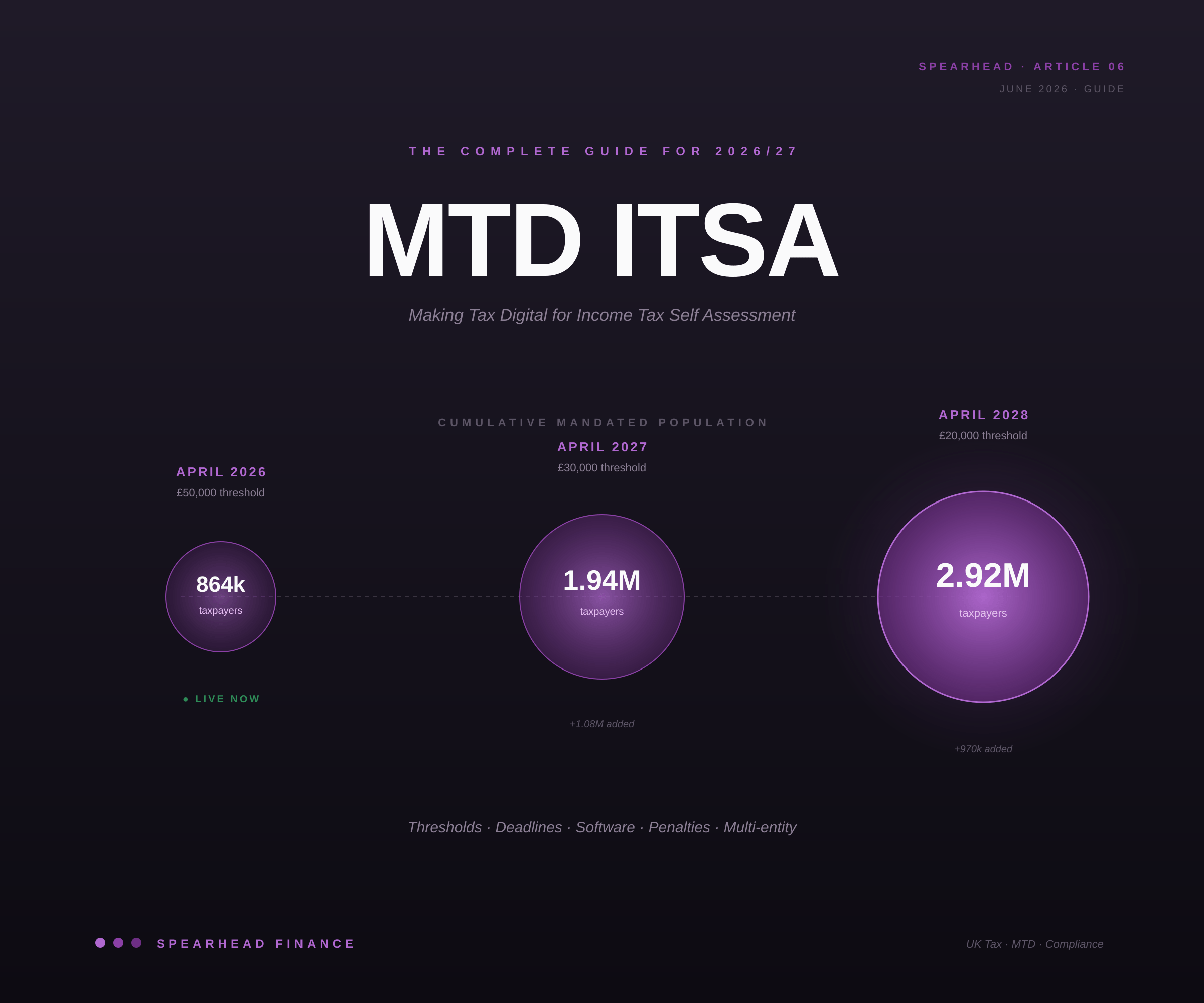
For thirty years, the British self-employed have filed their taxes once a year — typically on or around 31 January, typically accompanied by mild panic and large quantities of coffee. That era is over. On 6 April 2026, Making Tax Digital for Income Tax Self Assessment — known mercifully by its acronym, MTD ITSA — became the legal regime for 864,000 UK taxpayers. By April 2028, that population will be 2.92 million. The rules require quarterly digital updates to HMRC throughout the year, plus a final declaration at year-end, plus digital record-keeping in compatible software. This guide explains all of it: the thresholds, the deadlines, the software, the penalties, the multi-entity edge cases, and what to actually do about it. It is long. The contents below let you skip to what's relevant — though we'd suggest at minimum reading section 2 (Who has to comply?) and section 5 (Compliance timeline) before jumping to specialised material. If you'd rather just find out whether you need to worry, our two-minute MTD readiness quiz is faster. What is MTD ITSA? Making Tax Digital for Income Tax Self Assessment (MTD ITSA) is a UK government scheme that requires self-employed people and landlords above an income threshold to keep digital records of their income and expenses, and to submit quarterly updates to HMRC throughout the tax year, in addition to a final declaration at year-end. It replaces the once-a-year paper or online Self Assessment return for taxpayers in scope. That's the definition you can quote. The longer version is more interesting. MTD ITSA is the second major piece of HMRC's Making Tax Digital programme. The first — MTD for VAT — went live in April 2019 for VAT-registered businesses above the £85,000 threshold, and was extended to all VAT-registered businesses in April 2022. Most readers of this guide have already lived through MTD for VAT. MTD ITSA is the same idea applied to Income Tax for self-employment and property income. The official rationale is straightforward: more frequent reporting reduces the "tax gap" (HMRC's term for unpaid tax that ought to have been paid), improves the quality of self-reported figures, and brings UK tax compliance into the same century as UK online banking. The unofficial rationale, which HMRC will not write down, is that quarterly visibility into business income is much more useful to a tax authority than annual visibility — and the deflated probability of clever year-end accounting is a feature, not a bug. MTD ITSA's launch on 6 April 2026 was its third attempt at a launch date. It was first announced in 2015 by then-Chancellor George Osborne, under the impression that "every taxpayer would have access to their own digital tax account by 2020." It was then rescheduled to 2019. Then 2021. Then 2024. Then April 2026, for incomes above £50,000. Subsequent thresholds were delayed within the 2026 announcement to give software vendors time to actually build software. The current rollout schedule, which is the third version of the third version, is described in section 3 . Whether the current schedule survives contact with reality is a separate question. What's now live is real, though. As of mid-2026, MTD ITSA is law. 864,000 people are filing under it. The first quarterly deadline (7 August 2026) has been and gone. Who has to comply with MTD ITSA? You must comply with MTD ITSA if you are a UK sole trader or landlord whose combined gross self-employment AND property income for a tax year exceeds the relevant threshold for that year. From April 2026, the threshold is £50,000. From April 2027, it drops to £30,000. From April 2028, £20,000. That's the headline rule. The detail is where it gets more interesting. A few things to note about how the threshold actually works: It's "gross," not "net." The threshold is measured against turnover (the total amount you billed or received as income from self-employment and property), not against profit. A landlord with £35,000 of rental income and £15,000 of mortgage interest costs has £20,000 of net rental profit — but £35,000 of gross income, which is above the 2027 threshold. They will be in MTD ITSA scope from April 2027. It's "combined." Income from self-employment and income from UK property are added together. A consultant with £25,000 of consultancy income and a buy-to-let earning £15,000 has £40,000 combined — into scope from April 2027. It's "above," not "at or above." If your combined gross income is exactly £50,000 in 2025/26, you are not yet in scope. It's the rare edge case where rounding works in your favour. HMRC uses a two-year lookback. Your scope for tax year 2026/27 is determined by your gross income reported in your 2024/25 Self Assessment return — the most recent return HMRC had before the 2026/27 year started. This means a sudden jump in income in one year doesn't immediately catch you the same year; it catches you two years later. Employment income doesn't count. PAYE salary is invisible to MTD ITSA. Only the self-employment and property income components are measured against the threshold. A consultant who earns £80,000 from PAYE plus £15,000 from freelance work is not in MTD ITSA scope on those numbers, because only the £15,000 counts. Some taxpayers are exempt entirely. Trustees of trusts (who continue to use the standard Self Assessment regime), some categories of foreign-domiciled taxpayers, ministers of religion, members of Lloyd's syndicates, and people who can satisfy HMRC that they are "digitally excluded" (a high bar — limited internet access, religious objection, or specific disability). For everyone else above the threshold, MTD ITSA is mandatory. The 2026 / 2027 / 2028 phased rollout The thresholds drop in three waves. The cumulative population grows roughly 3.4× across the three years. Wave Date Threshold Newly mandated Cumulative population Wave 1 6 April 2026 £50,000+ 864,000 864,000 Wave 2 6 April 2027 £30,000+ +1,080,000 1,944,000 Wave 3 6 April 2028 £20,000+ +970,000 2,920,000 Wave 1 (April 2026 — live now) is the highest-income segment. It includes most professional contractors with single-tier limited company arrangements, the bulk of the buy-to-let landlord population with multiple properties, mid-tier sole-trader consultancy practices, and a long tail of high-income gig-economy participants. As of mid-2026, this wave is in motion. The first quarterly deadline (7 August 2026) has been met, missed, or extended on a case-by-case basis depending on the taxpayer. Wave 2 (April 2027) is the largest single addition. The drop from £50,000 to £30,000 captures around 1.08 million additional taxpayers — mostly mid-tier sole traders, smaller landlords, and the long tail of part-time self-employment that sits below the higher-earner threshold. This is the wave that creates the most aggregate practice workload, because it adds high volume at lower individual margin. Wave 3 (April 2028) captures another 970,000, this time at the lower end of the threshold band. The £20,000 floor brings in micro-traders, very small landlords (often with a single property), and gig-economy participants with regular self-employment income. By the end of this wave, MTD ITSA covers approximately 2.92 million UK taxpayers — roughly the population of Birmingham. HMRC has signalled an intention to extend further. No timeline currently exists for a fourth wave, and given the delivery history (see above), readers may take that signal with the appropriate level of seriousness. What MTD ITSA actually requires If you are in scope, you owe HMRC three things instead of one. 1. Digital records. Your income and expense records must be kept in MTD-compatible software. Paper notebooks are no longer compliant. Excel by itself is no longer compliant, though Excel connected to "bridging software" remains compliant — for now. The requirement is not just digital storage but functional compatibility: the software must be able to send the prescribed data structures to HMRC's MTD ITSA API. There is also a "digital links" requirement: data must flow electronically between any tools in your record-keeping chain. If you maintain transactions in Xero and then copy figures into a separate tool to submit, the copy must be an electronic transfer (export and import, API call, integration), not a manual retype. The point is to prevent transcription errors and reduce the opportunity for creative arithmetic. 2. Quarterly updates. Four times a year, you submit summary totals to HMRC for the relevant period. The default cycle uses the tax year's quarters: Q1: 6 April to 5 July, due by 7 August Q2: 6 July to 5 October, due by 7 November Q3: 6 October to 5 January, due by 7 February Q4: 6 January to 5 April, due by 7 May The quarterly update is not a tax return. It contains aggregate figures by income and expense category — broadly, what was earned and what was spent in each broad category — and HMRC uses these as interim data points. Quarterly figures can be amended later, in subsequent updates or in the final declaration. 3. The final declaration. By 31 January following the end of the tax year, you submit the final declaration. This consolidates the year's quarterly updates with everything else relevant to your tax position — employment income (if any), dividends, interest, capital gains, allowances, reliefs. The final declaration is what was previously called the Self Assessment return; the form has been restructured to fit within MTD-compatible software. For tax year 2026/27, the final declaration is due 31 January 2028. A common misunderstanding: MTD ITSA does not replace your annual Self Assessment with quarterly returns. It adds quarterly updates to it. The quarterly updates are not "four returns instead of one." The final declaration still happens. You now do five things where you used to do one. The compliance timeline and key deadlines For taxpayers in Wave 1 (in scope from April 2026), the 2026/27 cycle looks like this: Period Dates Submission due Q1 2026/27 6 April – 5 July 2026 7 August 2026 ✅ (passed) Q2 2026/27 6 July – 5 October 2026 7 November 2026 Q3 2026/27 6 October 2026 – 5 January 2027 7 February 2027 Q4 2026/27 6 January – 5 April 2027 7 May 2027 Final declaration 2026/27 tax year 31 January 2028 For taxpayers who would prefer to align the quarterly cycle with their accounting calendar — common for limited company directors whose company year-end falls outside 5 April — HMRC permits a calendar-quarter election. The election must be made before the start of the tax year and locks the cycle to calendar quarters (ending March, June, September, December) for that year. Most users on the default tax-year quarters will never need to think about this. Use the MTD deadline calculator to confirm your specific dates if your situation involves elections, mid-year status changes, or partnership arrangements. MTD ITSA-compatible software: the three layers HMRC publishes a list of MTD ITSA-compatible software. It contains, as of mid-2026, about eighty entries. Of those, perhaps a third are fully functional, another third are roadmaps with marketing, and another third are bridging tools for taxpayers who refuse to give up Excel. Choosing your software is a real decision, and the right choice depends on what category of taxpayer you are. The software market splits into three layers. Layer 1: Bookkeeping platforms. These record the underlying transactions — the bank feed, the categorised expenses, the invoices issued, the VAT return populated. Most modern bookkeeping platforms now handle MTD ITSA submissions for the entity they cover. The leaders in this segment are Xero, QuickBooks, FreeAgent, Sage, Zoho Books, and Coconut. Each handles the basics. Each operates per entity — one organisation file per limited company or sole-trade business. None handles synthesis across multiple entities. Layer 2: The synthesis layer. A newer category, addressing the problem that taxpayers with multiple entities (limited company plus personal SA plus dividends plus property SPV) have a "single tax position" that no single bookkeeping platform holds. The synthesis layer ingests data from one or more bookkeeping platforms and presents the consolidated multi-entity position. Our own product — TaxSync — sits in this layer. (For the deeper analysis of why this layer exists and why it matters, see The synthesis gap UK practices can't bill for .) Layer 3: Production tax software. These produce and file the formal returns that accountancy practices submit on behalf of clients. The market leaders are TaxCalc, IRIS Elements, BrightTax, Capium, and Nomi. They are designed for practices, not for end-users — a sole trader doesn't typically buy TaxCalc directly. If you're working with an accountant, your accountant's choice of production tax software affects how the work flows but is largely invisible to you. Free options exist for simple cases. HMRC itself offers a free MTD ITSA tool for sole traders with straightforward affairs. Several private companies (MyTaxDigital, untied, Pie Tax) offer free or freemium tiers. The free options work well for taxpayers with single income streams; they break down for the multi-entity cases that drive most professional contractor and SME-founder situations. How to choose: take the MTD readiness quiz for a tailored recommendation, or read Best MTD ITSA Software in 2026: An Honest Comparison for the detailed matrix. Penalties and the new points-based regime MTD ITSA uses a points-based late submission penalty regime. You receive one point for each missed quarterly update or missed final declaration. At four points (for quarterly submitters), HMRC issues a £200 penalty. Each subsequent late submission while at the threshold incurs an additional £200. Points expire after a sustained period of full compliance. Late payment penalties accrue separately, structured to escalate from the 15-day mark onwards. That's the snippet. The longer version: Late submission penalties are now applied as points, not as immediate fines. The first missed update earns one point — no fine. So does the second and third. The fourth missed update tips the taxpayer over the threshold, at which point HMRC issues a flat £200 penalty. From then on, every further missed update earns another £200, until the taxpayer achieves a sustained compliance period and points reset. The compliance period required to reset points is 24 months of full submission compliance for quarterly submitters (and 24 months for annual submitters). The point of the system is to discriminate between an occasional miss and a pattern of non-compliance; in practice, anyone who misses two quarters in a year is well on the way to the threshold. Late payment penalties apply separately. The system is designed to encourage prompt payment without immediately punishing short delays: Days 1–15 after the payment due date: no penalty if you pay, or formally agree a Time to Pay arrangement with HMRC. Day 16 onwards: a first late payment penalty starts to accrue, calculated as a percentage of the unpaid amount. Day 30 onwards: the first penalty completes, and a second penalty begins to accrue daily. Beyond day 30: the second penalty continues to accrue until the bill is paid in full. Specific rates change periodically and HMRC publishes current rates at gov.uk ; readers should check current figures rather than trust any specific percentage in an article that has been live for more than a few months. Late payment interest also applies on top, charged at a base-rate-plus-margin formula that is published quarterly. Reasonable excuse appeals. HMRC will sometimes accept a "reasonable excuse" defence, which removes the penalty if granted. The phrase "reasonable excuse" is doing a lot of work. Bereavement of an immediate family member typically qualifies. Serious illness typically qualifies. Catastrophic technology failure occasionally qualifies, particularly with persuasive screenshots. Being busy does not qualify. Being on holiday does not qualify. "I forgot" does not qualify. "My agent didn't tell me" does not qualify; the legal obligation rests with the taxpayer. Plan for the deadline, not the excuse. Multi-entity considerations The MTD ITSA rules are written as if the typical taxpayer has one set of records and one tax position. In practice, the people the rules catch first — higher-income professionals, multi-property landlords, SME founders — overwhelmingly have multiple entities, and the rules don't simplify the multi-entity situation, they multiply it. Contractors. A typical professional contractor structure: a personal Self Assessment, a trading limited company, dividends declared by the Ltd, potentially an inside-IR35 contract running through the Ltd, and (increasingly) a property SPV holding a buy-to-let. Five tax records, structurally. Each needs to be maintained in MTD-compatible software. The personal SA + property income components flow into MTD ITSA quarterly updates; the limited company has its own corporation tax filing (not MTD ITSA, but MTD for Corporation Tax is in the medium-term roadmap). Reconciling the five — making sure the Ltd's dividend declarations match the personal SA's dividend receipts, that IR35 deemed payments are imputed correctly, that SPV transactions don't leak into the personal CGT computation — is where most contractor accountancy fees are spent. For a deeper treatment, see Your tax position is one thing, not four . Landlords. A multi-property landlord operating in their personal name aggregates all rental income for MTD ITSA — there's a single property business, with the property income summed. A landlord operating through an SPV (a separate limited company) has the property income inside the Ltd, which is corporation-tax governed; their personal MTD ITSA position then only sees the dividends from the SPV. Mixed structures — some properties in personal name, some in SPV — are common and require the same reconciliation discipline as contractor structures. Joint-ownership properties are split between owners by the agreed beneficial-ownership percentage, and each owner's share counts toward their own MTD ITSA threshold. SME founders. A founder running a trading limited company typically has their personal income (director's salary, dividends from the Ltd) in MTD ITSA scope above the threshold, with the company itself outside MTD ITSA. If the company has its own commercial property in a separate SPV, or the founder has personal property income alongside, the synthesis problem grows. Founders running two or more limited companies face the same compound architecture. In every case, the complexity was always there; MTD ITSA hasn't made multi-entity affairs more complicated. It has made them more frequent. The same reconciliation now happens four times a year instead of once. How accountants are adapting For accountants, MTD ITSA has been simultaneously a windfall and a nightmare. A windfall because every client now needs help. A nightmare because the help is largely reconciliation work that wasn't in the fee quote. The fixed-fee model that powers most UK accountancy practices was built on annual workload assumptions. A multi-entity client who paid £200 a month for a once-a-year Self Assessment cycle now costs the practice three to five hours of reconciliation work per quarter, on the same £200 a month. Margins compress. Senior hours get redeployed to compliance from advisory. Junior hours fill the gap, sometimes successfully and sometimes not. Three responses have emerged in the market. Re-pricing existing clients. Some practices are renegotiating fees mid-year to reflect new workload. This is the conversation that ends partnerships; clients see the increase as opportunistic and shop around. Most practices avoid it where they can. Absorbing the loss. Others are accepting the margin compression in 2026/27, on the assumption that practice efficiency improves as MTD ITSA workflow tools mature. This is sustainable for a year, perhaps two. Restructuring the commercial model. A smaller number of practices are switching from per-seat tax software (the model that has dominated since the 1990s) to per-client wholesale pricing through synthesis-layer providers. This decouples software cost from headcount and embeds compliance tooling inside the client's fixed fee. For deeper treatment of this shift, see The synthesis gap UK practices can't bill for . The practices that will thrive over the next 18 months are those that figure out how to charge for the reconciliation work specifically — either by repricing, restructuring, or removing it from their workload entirely. Frequently asked questions When does MTD ITSA start? For incomes above £50,000, MTD ITSA started on 6 April 2026. The threshold drops to £30,000 from April 2027 and £20,000 from April 2028. Do I need MTD ITSA if I'm an employee? No. PAYE employment income doesn't count toward the MTD ITSA threshold, and PAYE income isn't reported through MTD ITSA. Only self-employment and UK property income matter. What's the deadline for the first MTD ITSA quarterly update? For the 2026/27 tax year's first quarter (April–July 2026), the deadline was 7 August 2026. For the second quarter (July–October 2026), the deadline is 7 November 2026. Can I still use spreadsheets? Yes — with bridging software. Pure Excel without an integration to HMRC's API is not compliant. Excel plus a compliant bridging tool that handles the digital link and submission remains compliant. Is MTD ITSA the same as MTD for VAT? No. MTD for VAT covers VAT-registered businesses; MTD ITSA covers Income Tax for self-employment and property income above the threshold. They are separate regimes with separate software requirements and separate deadlines, though many bookkeeping platforms handle both. What if my income is exactly £50,000? The threshold is "above" £50,000. If your combined gross self-employment and property income for the relevant year is exactly £50,000, you are not yet in scope. £50,001 catches you. Do I still file my Self Assessment? Yes — but it's now the final declaration, filed through MTD-compatible software rather than the HMRC online portal. For MTD ITSA taxpayers, the SA100 has been restructured into the final declaration form. What about CIS (Construction Industry Scheme)? CIS deductions continue to operate. The self-employment income they relate to is reported through MTD ITSA quarterly updates and reconciled in the final declaration like any other income. Can I do MTD ITSA myself, without an accountant? Yes. Many taxpayers do. The software market includes free and low-cost options designed for self-service, and for single-entity sole traders the workflow is manageable solo. Multi-entity taxpayers usually find an accountant more efficient. How much does MTD ITSA software cost? Free options exist for simple cases (HMRC's own tool, MyTaxDigital, untied free tier). Paid B2C options for individuals typically range £10–£75 per month. Multi-entity products like TaxSync Plus are around £75 per month. Production tax software for accountants is priced per seat or per client and varies widely. What happens if I cross the threshold mid-year? Your scope is assessed annually based on a two-year-prior return. If your 2024/25 return shows income above £50,000, you're in MTD ITSA scope from April 2026. A mid-year jump in income won't catch you that year; it catches you two years later. Are joint property owners both in MTD ITSA? Each owner's share of the gross rental income counts toward their individual threshold. A joint property earning £40,000 gross between two equal owners contributes £20,000 to each owner's threshold calculation. What about trading losses? Losses are reported through quarterly updates and finalised in the final declaration. Loss relief rules (carry-forward, set against other income, etc.) are unchanged by MTD ITSA — the underlying tax rules continue; only the reporting cadence has changed. Can my accountant file on my behalf? Yes. The HMRC agent authorisation framework (the 64-8 mandate and the Agent Government Gateway) extends to MTD ITSA. Your accountant submits on your behalf using their agent credentials, exactly as with the previous Self Assessment regime. What if I genuinely can't use digital tools? A limited exemption is available for taxpayers who can demonstrate digital exclusion — usually one of: very limited or no internet access, a documented disability that makes digital tools inaccessible, or a religious objection. HMRC must accept the case, and acceptance is not automatic. For the avoidance of doubt, "I prefer paper" is not a qualifying ground. What to do this month If you are in scope and unsure whether you are compliant, the order of operations is: Confirm your scope (use the readiness quiz or the threshold rules in section 2). Confirm your software supports MTD ITSA submission (check HMRC's published list). Confirm your records are in digital form, with no manual-retype links in the chain. Confirm your next quarterly deadline (use the deadline calculator ). If you have multi-entity affairs and are still reconciling in Excel, consider whether a synthesis layer is the right next step. MTD ITSA is the largest single change to UK Income Tax administration in three decades. It is real. It is law. It is, in some lights, even good policy. It is also, in most practical respects, a logistical inconvenience that doubles the number of dates the self-employed need to remember, and quintuples the number of submissions they need to file. Welcome to the new normal. The coffee remains permitted.