Best MTD ITSA Software in 2026: An Honest Comparison
· SF Admin
Eleven products. Three layers. Two audiences. We've scored every major MTD ITSA tool — including our own — across multi-entity support, pricing model, bookkeeping integration, and practice workflow. The honest verdict for each.
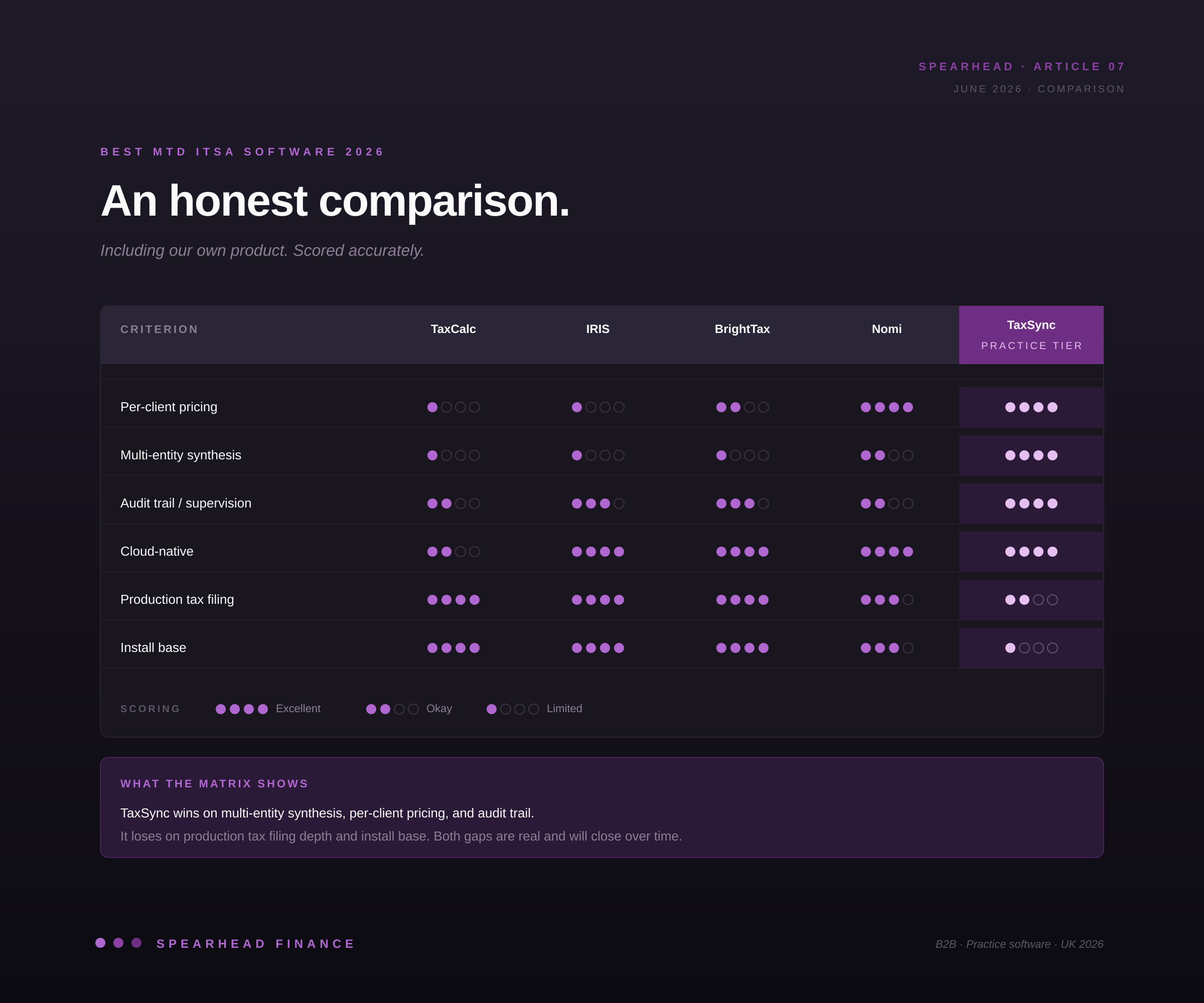
A confession before we begin: we make one of the products in this comparison. TaxSync Plus (for individuals and contractors) and TaxSync Practice Tier (for accountancy practices) are Spearhead Finance's products. We have a direct commercial interest in the outcome of this comparison. We've still tried to score honestly. Where TaxSync wins, we say so. Where it loses — install base, vertical specialisations, established workflow integration — we say that too. If you spot a score we've gotten wrong in either direction, email us and we'll correct it. This is the comparison we wish existed when we started looking at the MTD ITSA software market eighteen months ago. As of June 2026, it covers the eleven products that matter — six bookkeeping and tax tools for individuals and contractors, five practice-side platforms for accountants, plus the genuinely free options. The hero comparison matrix near the foot is what we'd recommend screenshotting if you want a one-page summary. If you don't yet know what MTD ITSA actually is, start with the pillar guide and come back. If you're a contractor specifically, the contractor-focused piece covers your scenarios at more depth. 1. The MTD ITSA software landscape The UK MTD ITSA software market is not one market. It's three. Layer 1 — Bookkeeping records the underlying transactions. Bank feeds, categorisation, invoices, expenses. Most modern bookkeeping platforms now handle MTD ITSA submission. Xero, QuickBooks, FreeAgent, Sage, Zoho Books, and Coconut all live here. They operate per entity — one organisation file per limited company or sole-trade business. Layer 2 — Tax-position synthesis is the layer above bookkeeping but below production tax. It holds a beneficial-owner's multi-entity tax position as a single view, ingests from bookkeeping platforms, and produces submission-ready data. Our own product — TaxSync — is purpose-built for this layer. It's a newer category with fewer entrants. Layer 3 — Production tax software is for accountancy practices. It produces and files the formal returns. TaxCalc, IRIS Elements, BrightTax, Capium, and Nomi compete here. Practice software is rarely bought directly by end-users — it sits inside the accountancy practice's stack. The reason this matters for any comparison: you cannot fairly compare Xero to TaxCalc. They're not the same kind of software. They sit in different layers. The right comparison question is "what do you need at each layer?" — and for most multi-entity taxpayers, the honest answer is "all three." For a deeper treatment of why the layered architecture exists, see the synthesis gap article . 2. What to look for The criteria that actually matter depend on who you are. If you're an individual taxpayer (sole trader, contractor, landlord): MTD ITSA recognition. Non-negotiable. Check the HMRC published list before buying. Multi-entity support. Single most important fork in the decision. Single-entity affairs are well-served by almost any tool; multi-entity affairs (Ltd + personal SA + dividends + property SPV) are well-served by very few. Bank feed quality. How reliable is the connection to your bank? How many UK banks are supported? How fast is the categorisation? Mobile app. If you'll be capturing expenses from your phone — and most people end up doing this — the app quality matters. Accountant collaboration. Can your accountant log in alongside you, with appropriate access controls? Price transparency. Watch for products where the headline price doesn't include MTD ITSA filing, or where add-ons stack up. If you're an accountancy practice: Pricing model. Per-seat vs per-client. The model that fits your firm's commercial reality. Multi-client dashboard. Can you see all clients' MTD ITSA status from one screen? Bulk operations. Can you act across many clients simultaneously — bulk submit, bulk review, bulk reconcile? Multi-entity synthesis. Can you hold a single client's multi-entity tax position as one record? Practice management integration. Workflow, AML, billing, client lifecycle. Audit trail. What happens when HMRC asks about a 2026 submission in 2031? Total cost at scale. Headline per-seat or per-client price multiplied by your real book size — the only number that matters at the end. 3. Software for individuals and contractors Xero Strengths: Industry standard. ~4.5M global users including ~1M+ UK. Mature MTD ITSA submission. The recent JAX partnership with Anthropic adds genuine agentic features (covered in the engineering piece ). Excellent ecosystem of integrations. Weaknesses: Per-organisation data model means multi-entity users typically run multiple subscriptions (one per Ltd, one per SPV) and reconcile manually. Cost stacks up fast for multi-entity contractors. Best for: Single-entity sole traders, SMEs running a single Ltd, contractors with simple structures. Verdict: If you're starting from zero and need bookkeeping, Xero is the safe default. The MTD ITSA layer is fine. The multi-entity story is not. QuickBooks (Intuit) Strengths: Strong UK presence. Good mobile-first capture experience. Native payroll integration. MTD ITSA recognised since early 2026. Weaknesses: Same per-organisation model as Xero. Customer support quality varies. UK feature set lags Xero in some areas. Best for: Small businesses already in the Intuit ecosystem; users who prefer the QuickBooks interface to Xero's. Verdict: Solid generalist. Comparable to Xero functionally, weaker on ecosystem. FreeAgent Strengths: UK-focused, built specifically for contractors and freelancers. Owned by NatWest — free for NatWest business banking customers, which is a substantial advantage if you bank there. MTD ITSA compliance built-in. Native CIS support. Weaknesses: Multi-entity story is limited — works well for one Ltd, struggles when you add SPVs or multiple companies. Less suitable as a business scales beyond the contractor archetype. Best for: Contractors with NatWest business banking. Single-Ltd contractors specifically. Verdict: Best free option for the right profile. The "free with NatWest" pricing is hard to beat if you fit it. Coconut Strengths: Free for 24 months with a Zempler business account. MTD ITSA recognised. Designed for the simplest sole-trader profile — categorise, submit, done. Weaknesses: Narrow feature set. Owned by GoSimpleTax, which sells a separate paid product. Limited scope for growth. Best for: Sole traders banking with Zempler who need the simplest possible compliance path. Verdict: Free is free. If you fit the profile, take it. If you grow beyond a single income source, you'll outgrow it. TaxSync Standard (£35/month) Strengths: Dedicated MTD ITSA submission for single-entity sole traders. 14-day free trial. Designed to complement rather than replace your bookkeeping platform. Weaknesses: Doesn't include bookkeeping — you still need Xero, QuickBooks, FreeAgent or similar alongside. At £35/month, it's a premium for what is essentially a tax submission layer over your existing books. Best for: Single-entity sole traders who want a dedicated tax tool separated from their bookkeeping platform. Verdict: For the single-entity user, this is overkill unless you specifically value separating the tax layer from the bookkeeping layer. Most users in this profile will be better off with their bookkeeping platform's built-in MTD ITSA submission. TaxSync Plus (£75/month) Strengths: The only product purpose-built for multi-entity beneficial-owner synthesis. Holds personal SA + Ltd + dividends + IR35 + property SPV as a single position. IR35 deemed-payment simulation. Dividend optimisation tools. Director loan account tracking across personal and Ltd. MTD ITSA quarterly submissions and final declaration. Integrates with Xero / QuickBooks / FreeAgent as data sources. Weaknesses: 50% off first month rather than a true free trial. Requires a bookkeeping platform alongside. At £75/month, materially more expensive than running Xero alone. New entrant — small but growing install base. Best for: Multi-entity contractors, SME founders with Ltd + personal SA + dividends, anyone running 2+ entities feeding into a single tax position. Verdict: If you have one Ltd and a Self Assessment, you're the target user. If you have a single income source, you're not. Honest about being purpose-built for a specific profile rather than for everyone. 4. Software for accountants TaxCalc Strengths: ~12,000 UK practices use it. Mature, comprehensive workpapers. Long track record. Cloud retrofit (CloudConnect) extends the desktop product. Strong CT600 production. Weaknesses: Desktop-first architecture retrofitted to cloud, not cloud-native. Per-seat pricing. Notable price increases in 2026 (~30%+ on some tiers) generating practice churn on review sites and AccountingWEB threads. The pricing trajectory is the dominant trade press story. Best for: Established practices with existing TaxCalc workflows; firms that value the depth of CT600/SA workpapers. Verdict: Solid incumbent under increasing commercial pressure. The depth of the product is real; the pricing posture is contested. IRIS Elements Strengths: ~18,000 UK practices. 90 of the top 100 firms. Comprehensive suite via the broader IRIS portfolio — Senta (practice management), Taxfiler (tax), Dext (bookkeeping data capture), AccountantsWorld. Genuine end-to-end coverage. Weaknesses: PE-owned (Hg Capital plus Leonard Green, £3.15bn valuation late 2023). Aggressive post-acquisition pricing trajectory is the open secret of the segment. Per-seat model. Implementation projects can run long. Best for: Mid-size and large practices wanting integrated suite; firms with the budget headroom to absorb suite pricing. Verdict: Dominant force in the segment. Comprehensive, expensive, increasingly so. BrightTax (Bright Group) Strengths: ~11,000 UK practices. Distinctive feature: HMRC final-declaration pull-down at year-end (industry-leading). Tightly integrated with Bright Group's other products (Bright Manager / AccountancyManager for practice management, MyWorkpapers for documentation). Solid modular product line. Weaknesses: Also Hg Capital-backed; same commercial trajectory concerns as IRIS. Modular pricing — features priced separately, total cost stacks up quickly. The "pick your modules" purchase experience is more complex than alternatives. Best for: Practices wanting tight integration of tax + practice management within one vendor. Verdict: Technically strong, commercially aggressive. Often a strong pick if budget supports the full module stack. Capium Strengths: Cloud-native all-in-one (tax, bookkeeping, payroll, practice management). 2020 Accounting Excellence winner. Transparent pricing from £18/month. Smaller install base means more responsive support. Weaknesses: Less ecosystem than IRIS or BrightTax. Smaller install base also means fewer external benchmarks. Less developed deep-tax workpapers compared to TaxCalc. Best for: Smaller practices (1-15 staff) wanting a single integrated cloud platform without the IRIS / Bright price tag. Verdict: Underrated. Worth shortlisting if you're cost-conscious and want cloud-native. Nomi (Nomisma) Strengths: Per-client pricing from £19/month + VAT — the closest commercial match in the incumbent market to the per-client wholesale model TaxSync runs. Modular tax features. Cloud-native. Genuinely transparent pricing. Weaknesses: Per-module add-ons stack up; the headline £19 doesn't include everything. Smaller install base than TaxCalc/IRIS/Bright. Less feature depth in workpapers. Best for: Small to mid-size practices wanting per-client billing economics. Verdict: The closest pre-existing pricing model to per-client wholesale. Worth direct comparison against TaxSync Practice Tier on commercial terms. TaxSync Practice Tier Strengths: Per-client wholesale (£15–£25 per client/month sliding by book size). Multi-entity beneficial-owner synthesis — purpose-built. Supervised autonomy + cryptographic audit chain (Ed25519 signing, hash-chained log — detail in the technical piece ). Co-branded practice portal. £150 monthly minimum, 12-month commitment, 17% annual prepay discount. Designed to embed inside the practice's existing fixed fee. Weaknesses: New entrant — small install base as of mid-2026 (~25 practices in pipeline, 2 fully converted, 12 in active referral). No standalone production tax filing for CT600 or non-MTD-ITSA returns — TaxSync handles MTD ITSA submissions but accountants typically run TaxSync alongside an existing production tax tool for corporation tax work. Less depth in practice management vs IRIS/BrightTax suites. Best for: Practices with 10–500 multi-entity clients (contractors, SME founders, landlords) wanting to recover the synthesis reconciliation time without re-pricing clients. Verdict: Best fit for the multi-entity wholesale scenario specifically. Honest about being a newcomer — if you want production tax depth and a large install base, you want IRIS or TaxCalc. If you want per-client wholesale and multi-entity synthesis, you want this. 5. Free MTD ITSA options Free options exist. They work well for simple cases and break down quickly when complexity arrives. HMRC's free MTD ITSA tool covers single-entity sole traders with straightforward income and expenses. No multi-entity. No advanced reporting. Designed as a safety net for the lower-threshold population from 2027 onwards. Available via HMRC's online services. MyTaxDigital is genuinely free bridging software — connect your existing records, submit to HMRC. No frills. Designed for users who'd otherwise have used spreadsheets and don't want to pay for a full bookkeeping platform. untied offers a free tier (Self Assessment basics) and a paid tier. Free tier handles simple cases; paid tier adds tax planning features. Pie Tax is AI-native — newer entrant with both free and paid plans. Worth tracking but earlier-stage than the alternatives. Coconut + Zempler and FreeAgent + NatWest are free with the associated banking — covered in section 3. The honest verdict on free: fine for very simple cases (one income source, basic expenses, no multi-entity). Inadequate for any contractor or SME founder running more than one entity. If your tax life is one bank account and one income source, the free tier is enough. If it isn't, it isn't. 6. The comparison matrix Scoring is on a 4-circle scale: ●●●● excellent, ●●●○ good, ●●○○ okay, ●○○○ limited, — not applicable. We've tried to score TaxSync as we would any other product. B2C: software for individuals and contractors Criterion Xero QuickBooks FreeAgent Coconut TaxSync Std TaxSync Plus MTD ITSA recognised ●●●● ●●●● ●●●● ●●●○ ●●●● ●●●● Multi-entity synthesis ●○○○ ●○○○ ●○○○ ●○○○ ●●○○ ●●●● Bank feed quality ●●●● ●●●● ●●●○ ●●●○ — — Mobile app ●●●● ●●●● ●●●○ ●●●○ ●●○○ ●●●○ Accountant collaboration ●●●● ●●●● ●●●○ ●○○○ ●●○○ ●●●○ Free option / trial ●●○○ ●●○○ ●●●● ●●●● ●●○○ ●○○○ Industry track record ●●●● ●●●● ●●●● ●●○○ ●●○○ ●●○○ B2B: software for accountancy practices Criterion TaxCalc IRIS Elements BrightTax Capium Nomi TaxSync PT Per-client pricing ●○○○ ●○○○ ●●○○ ●●○○ ●●●● ●●●● Multi-client dashboard ●●●○ ●●●● ●●●● ●●●○ ●●●○ ●●●○ Bulk operations ●●●○ ●●●● ●●●○ ●●●○ ●●●○ ●●●○ Multi-entity synthesis ●○○○ ●○○○ ●○○○ ●○○○ ●●○○ ●●●● Practice management ●●○○ ●●●● ●●●● ●●●○ ●●○○ ●●○○ Audit trail / supervision ●●○○ ●●●○ ●●●○ ●●●○ ●●○○ ●●●● Cloud-native ●●○○ ●●●● ●●●● ●●●● ●●●● ●●●● Production tax filing ●●●● ●●●● ●●●● ●●●○ ●●●○ ●●○○ Install base ●●●● ●●●● ●●●● ●●●○ ●●●○ ●○○○ Three observations from the B2B matrix: No incumbent scores well on multi-entity synthesis. This is the layer the market is missing and the reason we built TaxSync. No incumbent matches per-client pricing as a primary model except Nomi. The closest commercial alignment is Nomi; TaxSync extends per-client to all-inclusive wholesale. TaxSync loses cleanly on install base and production tax depth. A practice running 200+ clients on established TaxCalc / IRIS workflows is correctly served by those tools. The TaxSync win is in the multi-entity wholesale scenario specifically. 7. Which software fits which scenario "I'm a sole trader, single income, just need to comply." HMRC's free tool, MyTaxDigital, or Coconut/FreeAgent free tiers if you bank where they're free. Don't overspend. "I'm a contractor with a Ltd Co + personal SA + maybe one IR35 contract." Bookkeeping in Xero / QuickBooks / FreeAgent for the Ltd. TaxSync Plus as the synthesis layer for the consolidated multi-entity tax position. The combination handles your real complexity. "I'm a contractor with multiple Ltd Cos, dividends, and a property SPV." Same answer with stronger emphasis. The synthesis layer is the bottleneck in this scenario, and TaxSync Plus is the only product purpose-built for it. Bookkeeping platform per organisation; TaxSync as the single beneficial-owner view across them. "I'm an SME founder running a team of 3–10." TaxSync Pro (£125/month) — adds multi-user access, expense workflow, cash-flow forecasting, audit packs. Bookkeeping in Xero / QuickBooks as usual. "I'm a scaling SME with 20+ employees and an internal finance team." TaxSync Team (£200/month + £25/user) , or stay on existing tax tooling if it's working. The Team value proposition is the multi-entity synthesis and supervised audit chain across the company group. "I'm a small accountancy practice (5–25 clients), generalist." Capium or Nomi for core production tax. TaxSync Practice Tier if your client mix is meaningfully multi-entity (contractors with Ltd + SA, landlords with multiple properties). "I'm a mid-size practice (50–200 clients), generalist." IRIS Elements or BrightTax for full suite. TaxSync Practice Tier as a multi-entity wholesale layer if 20%+ of your book is multi-entity. "I'm a specialist contractor accountancy (200+ contractor clients)." This is the highest-fit scenario for TaxSync Practice Tier . Your entire book is multi-entity. The per-client wholesale economics and the synthesis layer recover senior hours specifically on the work your firm is most exposed to. "I'm a large practice (300+ clients) with established workflows." Stay with TaxCalc / IRIS / BrightTax. TaxSync's install base is too new to justify a wholesale switch at this scale. 8. Pricing summary The cheapest MTD ITSA software is HMRC's own free tool. Everything else is positioned against it. Product Headline price Notes HMRC free tool £0 Single-entity, basic features only MyTaxDigital £0 Bridging software, simple submission untied (free tier) £0 Self Assessment basics Coconut + Zempler £0 First 24 months with Zempler bank FreeAgent + NatWest £0 Free for NatWest business banking customers QuickBooks Simple Start from ~£10/month Bookkeeping + MTD ITSA Xero Starter from ~£14/month Bookkeeping + MTD ITSA, low transaction limits Capium (practice) from £18/month Cloud-native suite Nomi (practice) from £19/month + VAT per client Per-client pricing TaxSync Standard £35/month Single-entity tax layer TaxSync Plus £75/month Multi-entity tax synthesis TaxSync Pro £125/month SME with internal team TaxSync Practice Tier £15–£25 per client/month £150 monthly minimum, 12-month commitment TaxCalc varies, per-seat Recent ~30%+ increases reported BrightTax varies, modular Modules priced separately IRIS Elements varies, per-seat suite Enterprise pricing TaxSync Enterprise £10k–£50k+/month White-label, banks, large networks For TaxCalc, IRIS Elements, and BrightTax, headline pricing isn't publicly published in any meaningful form. Quotes are firm-specific and depend on seat count, modules, and negotiation. The trade press consensus as of mid-2026 is that the per-seat economics break down somewhere between 50 and 150 multi-entity clients, depending on the firm. 9. Frequently asked questions What's the cheapest MTD ITSA software? HMRC's own free MTD ITSA tool, for simple single-entity sole traders. MyTaxDigital is also genuinely free. Coconut (with a Zempler bank account) and FreeAgent (with NatWest business banking) are free for the right banking customers. Is there a truly free MTD ITSA option? Yes. HMRC's free tool covers simple cases. MyTaxDigital is independent free bridging software. They work for single-entity sole traders. They don't work for multi-entity contractors or SMEs. What's the best MTD ITSA software for contractors? For multi-entity contractors (Ltd + personal SA + dividends + IR35 + property SPV), TaxSync Plus (£75/month) is the only product purpose-built for the synthesis layer. For single-Ltd contractors with NatWest banking, FreeAgent is the best free option. What's the best MTD ITSA software for small accountancy practices? Capium or Nomi for cloud-native production tax. TaxSync Practice Tier specifically if your client book is multi-entity (contractor / multi-property landlord / SME founder mix). Does Xero do MTD ITSA? Yes. Xero's MTD ITSA submission is mature as of mid-2026 and the JAX partnership with Anthropic adds genuine agentic features. The limitation is that Xero operates per-organisation — multi-entity users typically need multiple Xero subscriptions or a synthesis layer alongside. Does QuickBooks do MTD ITSA? Yes. Same recognition as Xero. Same per-organisation limitation for multi-entity users. What's the difference between bookkeeping software and tax software? Bookkeeping software records transactions inside one entity (one company, one set of books). Tax software either produces returns (for accountants — TaxCalc, IRIS, BrightTax) or holds the consolidated tax position across multiple entities (synthesis layer — TaxSync). Many users need software at more than one layer. Can I use spreadsheets for MTD ITSA? Only with bridging software that connects the spreadsheet to HMRC's API. Pure Excel without a digital link to HMRC is not MTD ITSA compliant. MyTaxDigital provides this bridge. TaxCalc vs IRIS — which is better? TaxCalc has the deeper workpapers and the longer install history. IRIS Elements has the integrated suite (Senta, Dext, Taxfiler under one umbrella) and the larger top-end install base. TaxCalc has the more contested 2026 pricing trajectory; IRIS has the more sophisticated PE-driven commercial posture. Mid-size firms wanting integrated suite tend to land on IRIS; firms wanting depth in CT600 / SA workpapers tend to stay with TaxCalc. There is no single "better." Is TaxSync HMRC-recognised? TaxSync Standard, Plus, Pro, and Team are listed on HMRC's MTD ITSA-compatible software list. Practice Tier accesses the same submission capability via the practice portal. How do I switch MTD ITSA software mid-year? You can switch at any point provided your records remain complete and digital throughout the year. The receiving software needs to accept import from the source software. Most modern platforms support this; the friction varies. Switching mid-year is best done between quarterly cycles rather than mid-quarter. What software does HMRC recommend? HMRC doesn't recommend specific commercial products. It publishes a list of compatible software and recommends taxpayers choose based on their own needs. The free HMRC tool is HMRC's own option for simple cases. What to do next If you've got this far, you're either evaluating options seriously or doing competitive research. Either way: For individuals and contractors: the TaxSync Plus page has the multi-entity feature detail and the 50% first-month offer. If you'd rather sanity-check whether Plus is overkill for your situation, the readiness quiz takes two minutes. For accountancy practices: the Practice Tier overview covers the commercial structure and includes a Sarah-type worked example with full reconciliation maths. If you're at the point of seeing whether the per-client wholesale economics work for your book, a 30-minute call is the fastest way to model it. For deeper context: the pillar guide on MTD ITSA covers the regulatory framework. The contractor article covers the multi-entity scenarios in more depth. The synthesis gap piece explains why the layer that TaxSync occupies exists at all. We update this comparison every six months. If a product is missing, mis-scored, or has shifted since the last update, email and we'll fix it.