MTD ITSA Penalties Explained: What You Pay If You Miss a Deadline
· SF Admin
Missed an MTD ITSA quarterly deadline? Worried about an upcoming one? Here's exactly what happens — the points system, the £200 threshold, the late payment surcharges, and how to appeal a penalty. Calm, factual, complete.
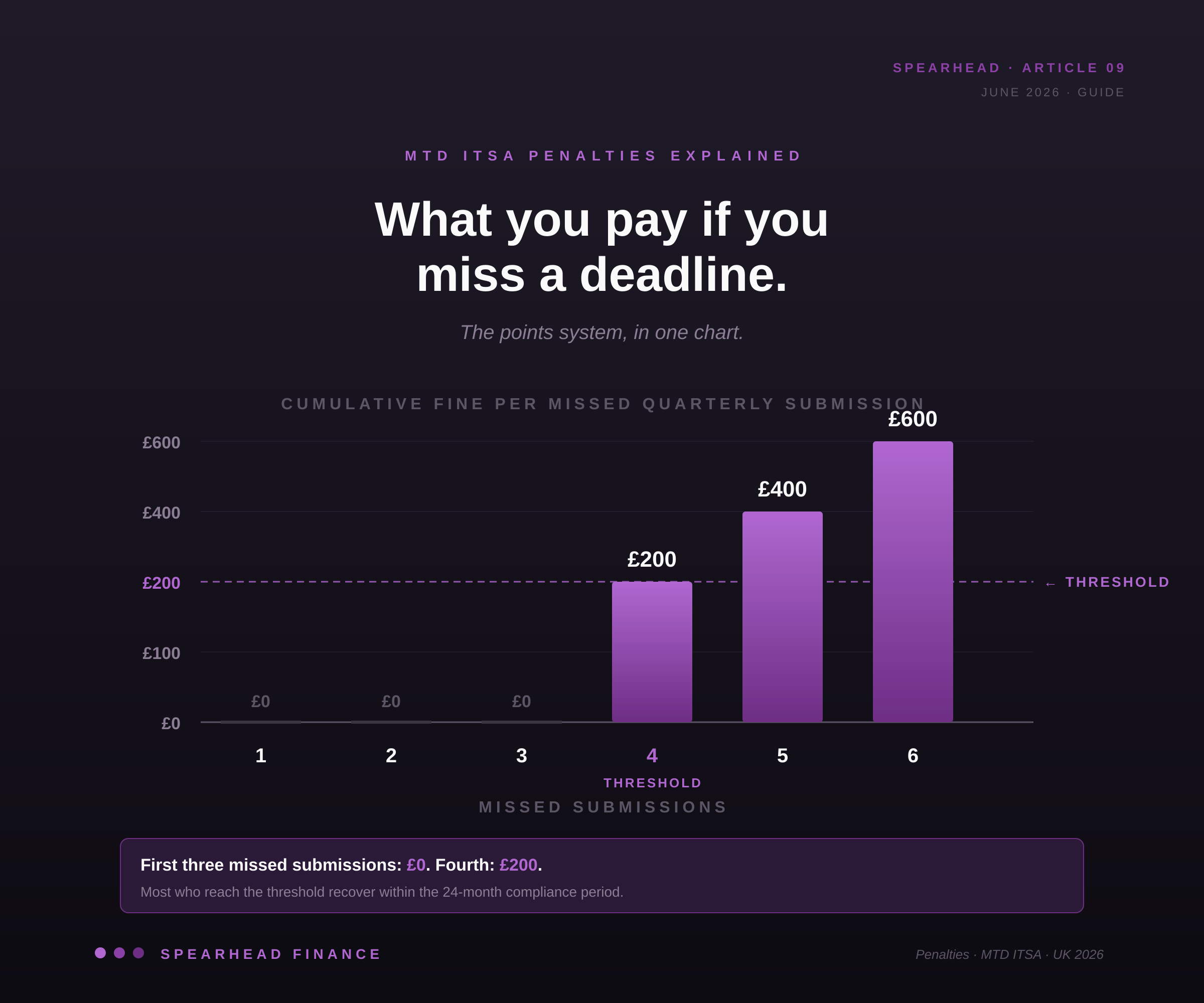
If you're reading this because you've just missed an MTD ITSA deadline — or you're worried you might — start with this single piece of information: Your first missed deadline does not trigger a fine. Neither does your second. Neither does your third. MTD ITSA uses a points-based late submission regime, not a per-incident fine system. Penalties depend on the pattern over time, not on any single missed deadline. The vast majority of taxpayers who miss one submission will not pay a penalty. That's the calming fact. The rest of this article explains exactly how the system works — the points, the thresholds, the financial penalties when they do apply, the separate late payment surcharges, and (importantly) the appeal process if you think a penalty was wrongly issued. If you've just missed a deadline, the practical action is at the foot of the article in section 9. If you're researching ahead of a deadline you haven't yet missed, the practical action is the same. Read whichever sections are useful; skip the rest. 1. How MTD ITSA penalties work MTD ITSA penalties operate as two separate systems: a points-based regime for late submissions, and a percentage-based regime for late payments. You receive 1 point for each missed quarterly update or missed final declaration. At 4 points (for quarterly submitters), HMRC issues a £200 penalty. Each further late submission while at the threshold incurs an additional £200. Points expire after 24 months of sustained compliance. The points system is deliberately more proportionate than the old per-incident fines. The thinking was that the original regime — which imposed an immediate fine for every late submission — disproportionately punished people whose lateness was a one-off rather than a pattern. The new points system gives people room to be human while still imposing meaningful consequences for sustained non-compliance. The two systems work in parallel: Late submission = points (and £200 penalties at the threshold). This is covered in sections 2 and 3. Late payment = percentage-based surcharges, separate from points. This is covered in section 4. You can be late on one without being late on the other. Submitting your quarterly update late incurs a point even if there's no payment due that quarter (which is normal — quarterly updates don't trigger immediate tax payments; the tax is settled at the final declaration). Paying your tax bill late incurs a payment penalty even if your submissions were on time. 2. The penalty thresholds For quarterly submitters — which is the vast majority of MTD ITSA taxpayers — the late submission point threshold is 4. Each missed submission accrues 1 point. Below 4 points: no financial penalty, just the point on your record. At 4 points: £200 penalty. Each subsequent miss while at threshold: another £200. Here's how it accumulates: Missed submissions Points Penalty Cumulative fine 1 1 None £0 2 2 None £0 3 3 None £0 4 4 (threshold reached) £200 £200 5 4 (already at threshold) £200 £400 6 4 £200 £600 A few important nuances: Points stay at the threshold once reached — you don't accrue more points past 4, but you do accrue another £200 fine for each subsequent miss while at threshold. Points expire after a sustained compliance period. For quarterly submitters, this is 24 months of full compliance with no missed submissions. After that period, your point count resets to zero. Final declaration counts as one point , the same as a quarterly update. There's no extra weighting for the annual filing. 3. Quarterly update penalties vs final declaration penalties For the points system, the two are treated identically. Missing a quarterly update accrues 1 point. Missing the final declaration accrues 1 point. The 4-point threshold applies to the combined total across both types of submission. But there's a critical difference when you bring late payment into the picture. A missed quarterly update on its own is "just" a point. Quarterly updates don't include tax payment — they're informational submissions of running figures. A missed or late final declaration is more consequential because the final declaration is when the year's tax is settled. If you file the final declaration late, you accrue a point for the late submission and — if you also pay the tax late — the late payment penalty regime kicks in separately for any unpaid tax. Two systems can both be triggered by the same delay. For this reason, the deadline that matters most financially is the final declaration deadline (31 January following the tax year). The quarterly deadlines matter for points; the final declaration matters for points and money. 4. The escalating surcharge system for late payment Late payment penalties are a separate mechanism from late submission points. They apply when tax is unpaid after the due date. How much is the fine for missing MTD ITSA tax payment? The rates are tiered by lateness: Days late Penalty Notes 1–15 None Provided you pay, or formally agree a Time to Pay arrangement with HMRC 16–29 2% of unpaid amount Calculated on the amount outstanding at day 15 30 Additional 2% (4% total first penalty) Calculated on the amount outstanding at day 30 31+ Second penalty accruing daily Annualised rate around 4% on the outstanding balance, until paid In addition to these penalties, late payment interest is charged on any unpaid amount from day 1 (not from day 15). The interest rate is set by HMRC and changes periodically; as a rule of thumb it tracks Bank of England base rate plus a margin. Specific rates change — check gov.uk for current figures rather than relying on any specific number in an article more than a few months old. A practical illustration: suppose you owe £5,000 in tax and pay it 45 days late. First penalty: 4% × £5,000 = £200 Second penalty (~15 days at annualised 4%): ~£8 Late payment interest (~45 days at ~9% annual): ~£55 Total ~£263 on top of the £5,000 owed The penalties scale with both the amount and the delay. Small amounts paid only a few weeks late incur modest penalties; large amounts left unpaid for months become expensive quickly. 5. Worked examples Five common situations, each with the actual penalty maths. Scenario A: You missed Q1 only. 1 point. £0 penalty. HMRC sends a notice within 4–6 weeks. You should file Q1 as soon as possible, but the financial exposure is zero. Scenario B: You missed Q1 and Q2. 2 points. £0 penalty. You're halfway to the threshold but still without financial exposure. File both missed submissions immediately. Scenario C: You've missed Q1, Q2, and Q3. 3 points. £0 penalty. You're one missed submission away from the £200 threshold. Highest-priority action: file Q4 on time. Filing the missed Q1–Q3 catches up the record but doesn't reduce points. Scenario D: You've missed all four quarterly updates. 4 points (threshold reached). £200 penalty issued. File all four immediately. The threshold won't reset until you complete 24 months of full compliance, which means filing the upcoming Q1–Q4 of the new tax year on time. Scenario E: You filed your final declaration but paid the tax 25 days late. Late submission points: 0 (the declaration was on time). Late payment penalty: 2% of unpaid tax (since you're past day 15 but not yet day 30). Plus late payment interest accruing from the due date. In every scenario, the practical action is the same: file the missing submissions as soon as possible, pay any outstanding tax (or agree a Time to Pay arrangement), and put systems in place to ensure the next deadline is met cleanly. 6. What happens if you miss your first deadline If this is your first missed MTD ITSA deadline, the immediate consequences are straightforward: 1 point added to your compliance record No financial penalty A notice from HMRC by post, usually within 4–6 weeks of the missed deadline An expectation that you file the missing submission as soon as practicable That's it. You don't owe HMRC any money for the late submission itself (you may owe interest if there was a payment due — but the late submission point doesn't carry a fine). The notice will tell you you've been added a point. It is, structurally, a warning. What to do: file the missing submission within a few weeks if you can. If circumstances make that genuinely difficult, document the reason — you may have grounds for an appeal (see section 8). Plan the next deadline carefully. Most first-time missers never miss again. 7. What happens if you miss several deadlines Once you accumulate two or three missed submissions, the urgency increases — not because of cumulative fines (there still aren't any below 4 points) but because the next miss triggers the £200 threshold. At 2 points: no penalty, but you're now exposed. At 3 points: no penalty, but one more miss = £200. At 4 points: £200 penalty issued. At 5+ points (or rather, at threshold + each subsequent miss): an additional £200 for every further miss. You receive a separate penalty notice for each missed submission once at threshold. Each notice has its own 30-day appeal window. Long-running non-compliance — accumulating five or more missed submissions over multiple years — increases the likelihood that HMRC opens a more serious enquiry into your overall tax affairs. The points system is designed to catch patterns; HMRC's wider scrutiny follows patterns too. If you're at 3 points or more, the focus should shift entirely from "what's the fine?" to "how do I prevent the next miss?" Section 9 covers this. 8. How to appeal a penalty (reasonable excuse) HMRC accepts appeals against penalties on the grounds of "reasonable excuse." You must submit the appeal within 30 days of the penalty notice, either online via the HMRC portal or in writing. What HMRC has historically accepted as reasonable excuse: Bereavement of a close family member around the deadline Serious illness, with supporting medical evidence Fire, flood, or theft affecting your records or premises Technology or software failure preventing submission (with evidence — screenshots, error messages, vendor confirmation) A disability that made compliance impractical without specific support that was unavailable What HMRC has historically rejected: "I forgot" or "I didn't know about the deadline" "I was on holiday" "Work was busy" "The software was difficult" "My accountant didn't tell me" (the legal obligation rests with you, not your agent) General financial difficulty A successful appeal should be specific, factual, and supported by evidence where available. Show what you tried to do, when, and what specifically prevented you. Show that you took immediate action to remedy the situation once able. HMRC's appeals officers respond to clarity and documentation; they don't respond to general excuses or appeals to fairness. If your appeal is rejected, you can take it further — first to an HMRC review, then to the First-Tier Tribunal. Most appeals don't get that far; either they succeed at the first stage or they don't. 9. How to avoid penalties Three categories of prevention, in increasing order of robustness: Deadline awareness. Calendar reminders, phone alerts, the MTD deadline calculator tool. Free, but only as good as your habit of looking at the calendar. Most missed deadlines happen because someone genuinely forgot the date or misjudged how long preparation would take. Software automation. MTD-compatible software that prompts you ahead of deadlines, pre-populates the submission, and submits with one click. Most modern bookkeeping platforms now include this; check that yours is on HMRC's recognised list and that the prompts are enabled. Supervised submission. Software that prepares the submission in advance and queues it for your approval — leaving you only the final sign-off rather than the entire workflow. This is what TaxSync's Authority Levels do: Level 3 prepares the quarterly update automatically based on the synthesised data; Level 4 requires your approval before submission to HMRC. Combined with three-stage deadline reminders (6 weeks, 2 weeks, 1 week), the structural risk of missing a deadline drops materially. The most expensive penalty is the one you pay because you didn't put a £75/month system in place to prevent it. TaxSync Plus is £75/month with 50% off the first month. The 14-day trial doesn't require ongoing commitment. Frequently asked questions What's the maximum MTD ITSA fine? There's no formal cap. Each missed submission while at the 4-point threshold incurs £200, and you can theoretically accrue unlimited £200 penalties by continuing to miss. In practice, most taxpayers who reach 4 points stop missing — either because the £200 notice prompts action or because they put a software system in place to prevent further misses. Do MTD ITSA penalties get backdated? No. The points system starts when you become subject to MTD ITSA (April 2026 for the first wave, April 2027 and April 2028 for subsequent waves). Anything pre-MTD-ITSA isn't subject to the new regime. Can I just pay the £200 and ignore the rest? No. The £200 is the penalty for missing the submission; you still need to file the submission itself. Continuing to miss further submissions while at the threshold means another £200 per miss. Paying the penalty without filing doesn't resolve the underlying compliance issue. How does HMRC notify me of a penalty? By post, usually within 4–6 weeks of the missed deadline. The notice states the missed submission, the point added (or the £200 penalty if at threshold), and the appeal window (30 days from the date of the notice). Can I get points removed from my record? Yes, via two routes: a successful appeal on reasonable excuse grounds (see section 8), or by completing the compliance period (24 months of full compliance for quarterly submitters). After the compliance period, your point count resets to zero. Do MTD ITSA penalties show on my credit record? No. Tax compliance is a private matter between you and HMRC. It is not reported to credit reference agencies and doesn't affect your credit score. What if I'm late paying but my submissions are on time? Late payment penalties apply separately, calculated as percentages of the unpaid amount (see section 4). On-time submissions means no points accumulated, regardless of payment status. What if HMRC says I've missed a deadline I haven't? Appeal immediately with proof of submission — confirmation receipts from your MTD-compatible software, time-stamped HMRC acknowledgements, or screenshots of the submitted return. HMRC accepts genuine error corrections, but the burden of proof is on you. What to do right now If you've just missed a deadline: file the missing submission as soon as practicable. The point applies regardless, but filing quickly reduces the likelihood of further complications and demonstrates good faith if you later need to appeal. If you're approaching a deadline you're worried about: submit even if imperfect. You can amend a quarterly update later; you can't un-miss a deadline. An imperfect on-time submission accrues no points and creates a record that can be corrected at the next opportunity. If you've already accrued points and want to prevent the next miss: the structural solution is software that prepares the submission ahead of the deadline and prompts you for approval. TaxSync Plus is purpose-built for this scenario — three-stage deadline reminders, supervised Level 3 preparation, one-click Level 4 approval. £75/month with 50% off the first month. The 14-day trial doesn't require commitment. Start your TaxSync Plus subscription → For practising accountants managing client penalty exposure across a book: the Practice Tier includes practice-level deadline orchestration across all clients with a single dashboard. For the broader regulatory context, see the MTD ITSA pillar guide . If you're a contractor specifically, the contractor article covers your scenarios. The penalty regime is more forgiving than people fear. Most situations are recoverable. Most patterns can be reset. The work is forward-looking — what you do from now on matters more than what happened last quarter.