Per-Seat vs Per-Client: How MTD ITSA Is Breaking the Accountancy Pricing Model
· SF Admin
For thirty years, accountancy software has been sold per-seat. MTD ITSA broke the economics that made that pricing model work. Here's the maths on a 50-client practice — and the three commercial structures emerging in response.
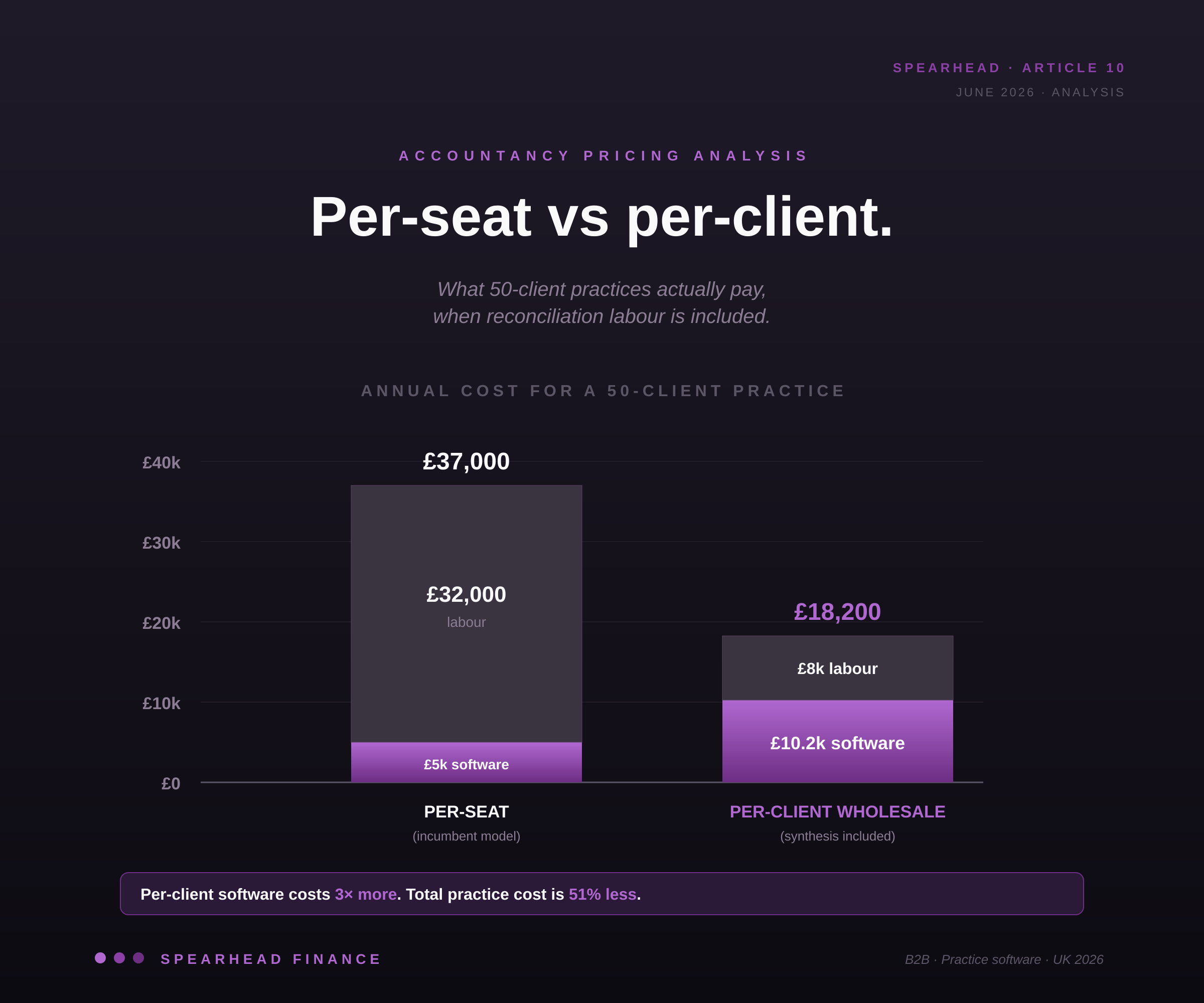
Accountancy software has been sold per-seat for thirty years. The model worked because the underlying economics worked: a practice's client volume per professional was relatively stable, software cost was a small fraction of revenue, and the deliverable that mattered was the professional's hours. MTD ITSA broke each of those assumptions. Client work per professional became materially more demanding (5x more submissions per client per year, plus the multi-entity reconciliation work that scales worse than linearly). Software cost stayed flat while delivery cost rose, compressing the margin gap. And the deliverable that increasingly matters isn't the professional's hours — it's the synthesis work that the software does, or fails to do, on the professional's behalf. This article makes the structural case for per-client wholesale pricing as a response to MTD ITSA-era margin compression. The maths for a typical 50-client practice is in section 6. We — Spearhead Finance — sell one of the per-client products in this market (TaxSync Practice Tier), so the analytical posture here is interested. The numbers should hold up regardless. For the underlying argument framed less analytically, see The synthesis gap UK practices can't bill for . For the full software comparison across both pricing models, see Best MTD ITSA Software in 2026 . 1. The pricing model accountancy software has used for 30 years UK accountancy software has been per-seat since the 1990s. TaxCalc, IRIS, Sage Personal Tax — all priced per professional user, typically per module. A 6-staff practice with full module access (tax preparation, accounts production, AML, practice management) could be paying £10,000 to £25,000 a year, depending on tier and modules. The economic logic was straightforward. A practice's professional headcount was relatively stable. The software was the professional's tool — a productivity multiplier for the human work that constituted the deliverable. Per-seat pricing aligned the software vendor's revenue with the practice's labour cost, which was the largest variable cost the practice managed. This logic worked when three conditions held: Each professional's client capacity was roughly stable year-on-year Software costs were a small fraction of practice revenue (typically 5–10%) The professional's hours were the deliverable, with software as the productivity tool Per-seat pricing was the right answer to the question "how should accountancy software be priced?" for thirty years. Then, between April 2025 and April 2026, the question changed. 2. What MTD ITSA changed MTD ITSA went live on 6 April 2026 for taxpayers above £50,000 income, with thresholds dropping to £30,000 in April 2027 and £20,000 in April 2028. For practices, the cycle shifted from one annual touchpoint per client to five (four quarterly updates plus a final declaration). The headline figure — 5x more submissions — understates the practical impact. The submissions themselves are largely automated by the time they reach HMRC. The work upstream of submission grew much more than 5x for the practice's multi-entity clients, because each quarterly cycle requires reconciliation across the client's bookkeeping, dividends, IR35 deemed payments, property holdings, and personal Self Assessment. Industry estimates (and our own work with partner practices) put the reconciliation labour at 3–5 hours per multi-entity client per quarter — somewhere between 12 and 20 hours per client per year. For a 50-client practice with a typical multi-entity mix, that's 600 to 1,000 hours per year of reconciliation labour that wasn't in the pre-MTD workload. At blended senior+junior costs of £40–£50 per hour fully loaded, that's between £24,000 and £50,000 of new labour cost per year — which the per-seat software licence didn't move to cover. The software licence covers professionals; the work that ate the margin is professional work. 3. Why fixed-fee practices are seeing margin compression The fixed-fee model that most UK practices operate was priced against the old workload. A typical multi-entity client paying £200 a month (£2,400/year) was covering approximately 15 hours of senior time annually — about £160/hour fully loaded, which sustained a 30% practice margin. Post-MTD, the same client requires 27 to 35 hours of senior time on the same £2,400 fee. That's an effective rate of £69–£89/hour fully loaded — a margin compression of nearly 50%. A practice with 50 multi-entity clients absorbs an extra £30,000–£50,000 of professional time annually that the existing per-seat software licence doesn't help recover. The maths is harder than it looks. The labour cost is real but it's spread across professionals already on payroll, so the immediate cash hit isn't always obvious. The practice management report in October shows margins down 10–15 points without anyone being able to point to a single line item that explains it. The line items are scattered across reconciliation hours that were absorbed into "client management" or "year-end prep" in the timesheet codes. Practices that don't restructure pricing or restructure tooling in response will spend 2026/27 watching this compression continue. Practices that do restructure are looking at two reactive responses and one structural one. 4. The two responses currently being attempted Two reactive responses dominate the market right now. Both are honest. Both have downsides. Re-pricing existing clients. The conversation goes: "MTD ITSA has materially changed what we deliver. The fee needs to move up by X% to reflect that." Typical increases being attempted are 30–60%. The conversation is uncomfortable because clients don't see the increased delivery work — they see the same five entities, the same returns, the same accountant. They see the increase as opportunistic. Practices report client churn rates of 5–15% on re-pricing rounds, with churn concentrated in the lowest-touch clients (the ones who were paying the most relative to delivery effort). The retained client base is more profitable but smaller. Absorbing the loss. The bet is that efficiency gains from new software, from improved categorisation rules, from junior hires, will catch up with the cost over 12–24 months. This is plausible. It is also a bet — and the practice is making the bet with its 2026/27 margin in the meantime. Practices that absorb without restructuring their toolchain are taking the bet on the existing toolchain catching up, which assumes the per-seat vendors will materially solve the reconciliation problem inside the existing pricing structure. There's not strong evidence they will. Both responses are scoped to the existing pricing model. The structural alternative is to change the pricing model. 5. The structural alternative: per-client wholesale pricing Per-client wholesale inverts the per-seat assumption. Instead of charging the practice per professional user, the vendor charges the practice per client managed in the software, on a wholesale basis embedded inside the practice's fixed fee. The mechanics: The vendor sells to the practice at a per-client per-month rate, typically £15–£25 sliding by book size The practice charges the end-client a fixed fee, unchanged by the vendor's wholesale cost The wholesale rate is structured to include the synthesis work — the multi-entity reconciliation that the per-seat model left to manual labour A 12-month commitment and 17% annual prepay discount are standard terms The pricing tier structure typically: Under 10 clients: £25/client/month 10–25 clients: £20/client/month 25–50 clients: £17/client/month 50+ clients: £15/client/month £150 monthly minimum This is structurally different from per-seat in three ways: Software cost scales with the practice's client book, not with professional headcount. A small practice serving 20 clients pays less than a large practice serving 200. The vendor's revenue grows when the practice's book grows. This aligns incentives. The synthesis work is included in the wholesale rate, not added on top. The labour cost that the per-seat model left to professional reconciliation hours is what the per-client model is paid to do. The wholesale rate isn't just software access — it's the synthesis layer doing the reconciliation work. The practice keeps the client relationship and the client pricing. The vendor sells to the practice, not to the client. The client never sees a per-client subscription. The practice keeps the fixed-fee model that clients are used to, with the per-client wholesale rate embedded inside it. 6. A worked comparison — 50-client practice Take a 50-client practice with a typical multi-entity client mix. Compare the actual annual cost under each pricing model. How much does MTD ITSA software cost per client? Under per-client wholesale at the 50-client tier (£17/month), the cost is £204 per client per year, or £10,200 for the practice. Under per-seat pricing, the software cost itself is lower per-client (£70–£100), but the reconciliation labour the per-seat model leaves unsolved adds £400–£700 per client to total delivery cost. The honest comparison includes both the software cost and the labour cost the software doesn't cover. Cost component Per-seat (incumbent) Per-client wholesale Software (6-seat practice, tax module + practice mgmt) ~£5,000 £10,200 Reconciliation labour (3–5 hrs/client/quarter × 50 clients × £40/hr) ~£32,000 ~£8,000 Total annual cost ~£37,000 ~£18,200 Per-client total ~£740 ~£364 The counterintuitive result: per-client wholesale is 3× more expensive on headline software cost but roughly 50% cheaper in total practice cost. The £8,000 of residual labour under per-client reflects the work that remains even with the synthesis layer doing the heavy lifting — review, approval, edge-case handling, advisory conversations with the client. The synthesis layer doesn't eliminate professional judgement; it eliminates the manual reconciliation that didn't need professional judgement in the first place. Two important caveats on these numbers: The £5,000 per-seat software figure is conservative for a 6-staff practice; full-suite IRIS Elements or TaxCalc with all modules can be £10,000–£20,000. The labour cost differential gets larger with the larger software cost, not smaller. The 75% reduction in reconciliation labour under per-client wholesale assumes the synthesis layer is functioning well. In year one of any new tooling, the reduction is closer to 50% as workflows mature. By year two, 75–85% is realistic. 7. Why per-client only works as a wholesale model A common reaction to per-client pricing is: "Couldn't the vendor just sell direct to my clients for £15/month?" Theoretically yes. Practically, no — and not because of the technology. Because of the economics. If the vendor sells per-client direct to end-clients: Clients balk at "yet another subscription" added to their existing setup The practice loses the client relationship and the markup The vendor's CAC per end-client is much higher than CAC per practice (because end-clients are smaller, more distributed, harder to acquire) The practice has no commercial reason to recommend the vendor If the vendor sells per-client list-price to practices (no wholesale arrangement, just per-client billing): The practice resists because list-price caps margin The practice's incentive to push adoption disappears The vendor's average revenue per practice is artificially constrained The wholesale arrangement makes the economics work for everyone: Practice charges the client an unchanged fixed fee (£200/month), keeping the existing client relationship and the markup Practice's effective cost drops because the wholesale rate (£17/month) replaces the £400–£700 of reconciliation labour per client per year Vendor gets predictable recurring revenue per practice (one customer relationship per practice, scaled by book size) End-client sees no change to their bill, doesn't acquire a new subscription, doesn't experience the friction of a new vendor relationship This is why the per-client model has emerged as wholesale rather than list-price. The economics aren't symmetric across direct and wholesale routes; the wholesale route is materially better for all three parties. 8. Three commercial structures that emerge In a market where per-client wholesale is the structurally better answer, three commercial structures emerge. Each has its place. 1. Per-client wholesale (primary). The vendor sells to the practice on a per-client per-month basis with 12-month commitment, £150 monthly minimum, and tiered pricing by book size. The practice keeps the client relationship and pricing. The reconciliation work is included in the wholesale rate. This is TaxSync's Practice Tier model, and the closest pre-existing alignment in the market is Nomi's per-client pricing structure. The economics are best for practices with substantial multi-entity client books. 2. Hybrid (per-seat + per-client). The practice keeps its existing per-seat tax software for production work (CT600s, accounts production, non-MTD-ITSA returns) and adds a per-client synthesis layer for the MTD ITSA multi-entity reconciliation work. This costs more in total than either model alone, but it allows incremental adoption and smaller transition risk. It works when the practice has invested heavily in existing per-seat tools and wants to layer rather than switch. Most practices considering TaxSync Practice Tier start here for the first 12 months. 3. Referral. The vendor sells direct to the end-client (or to a sub-segment of end-clients), and the practice receives a referral commission (typically 10–20% of subscription value). The practice never touches the synthesis software directly. This works for practices that want to extract value from the structural shift without taking on the tooling change themselves. The per-client revenue is recurring as long as the client remains subscribed, which gives a long tail of referral income for relatively low effort. Practices that have stress-tested their margin position through 2026/27 generally find that structure 1 (full per-client wholesale) yields the best long-term economics for multi-entity client books, but structure 2 (hybrid) yields the best risk-adjusted transition path. 9. What this means for the next 18 months The pricing shift is not going to reverse. Three predictions about the trade for the next 18 months: Per-seat survives, but for a narrower scope. Per-seat is well-suited to advisory work, complex bespoke engagements, and one-off projects where the deliverable genuinely is the professional's hours. Per-seat is poorly suited to recurring compliance work where the deliverable is increasingly the software's synthesis. The market will split — per-seat retains advisory and complex work, per-client takes compliance and routine multi-entity reconciliation. Incumbent per-seat vendors will introduce per-client tiers. TaxCalc, IRIS Elements, BrightTax will all eventually launch per-client billing options. The challenge for incumbents is that retrofitting per-client billing onto a per-seat-architected codebase is non-trivial. Early per-client offerings from incumbents in 2026/27 will likely be priced higher than wholesale-architected entrants (TaxSync, Nomi, future entrants) because they're operating with higher cost-to-serve. Pricing will compress over 12–24 months. Pricing trajectory of incumbent per-seat tools will be the dominant trade press story. TaxCalc's ~30%+ price increases through 2026 are already generating AccountingWEB threads. IRIS's PE-backed pricing structure (Hg Capital + Leonard Green, £3.15bn valuation in late 2023) implies a pricing trajectory designed for ongoing revenue extraction. As practice margins compress, practice tolerance for incumbent pricing increases will fall. The incumbents have a window to introduce per-client pricing competitively; if they miss it, market share moves to per-client-native vendors. The strategic question for practices in 2026/27 isn't whether to switch. It's whether to commit to the legacy model and absorb the margin compression, hedge with hybrid tooling, or restructure fully toward per-client wholesale. The maths in section 6 suggests the last option is structurally cheapest for any practice with a multi-entity client book of 25 or more. Frequently asked questions How much does MTD ITSA software cost per client? Under per-client wholesale pricing, MTD ITSA software typically costs £15–£25 per client per month, sliding by practice book size. At 50 clients, the wholesale rate is around £17 per client per month, or £10,200 per year for the practice. This is structurally different from per-seat pricing, where the practice pays per-professional regardless of client count. Is per-client always cheaper than per-seat? For multi-entity client books (contractors with Ltd + SA + property, SME founders, landlords with SPVs), per-client wholesale is typically 30–50% cheaper than per-seat when reconciliation labour is included in the comparison. For single-entity client books (simple sole traders), per-seat may be cheaper because the reconciliation labour is minimal. What's the minimum commitment for per-client wholesale? Typical per-client wholesale arrangements (including TaxSync Practice Tier) require a 12-month commitment, a £150 monthly minimum, and an upfront 17% annual prepay discount. Shorter commitments are sometimes available at higher per-client rates. Can I keep my existing per-seat software and add per-client wholesale? Yes — this is the hybrid structure (see section 8). Many practices run per-seat tax software for production work (CT600s, accounts production, non-MTD-ITSA returns) and add a per-client synthesis layer specifically for MTD ITSA multi-entity reconciliation. Cost is higher than either pure model but transition risk is lowest. Will TaxCalc, IRIS, or BrightTax introduce per-client billing? Probably, within 18–24 months. The challenge for incumbents is that per-client billing requires a different cost-to-serve architecture than per-seat. Early incumbent per-client offerings will likely be priced higher than wholesale-native vendors until cost structures align. Does this only work for big practices? No — the inverse is more accurate. Small practices (5–25 clients) benefit most from per-client wholesale because their per-seat costs are amortised over a small client base. A 10-client practice paying £4,800 a year on TaxCalc seats is paying ~£480/client/year for software alone; the same practice on per-client wholesale at £25/client/month is paying £300/client/year and absorbs the reconciliation labour. What about practices with mixed client mix (some simple SAs, some multi-entity)? The economics work best when the majority of the book is multi-entity. For mixed books, the hybrid structure (section 8 option 2) typically wins — per-seat for the simple SA clients, per-client for the multi-entity ones. The per-client cost is only incurred on clients who benefit from synthesis. What to do next If you're a practice partner or manager looking at margin compression in 2026/27 and considering whether per-client wholesale is the right response: the Practice Tier overview covers the commercial structure in detail, including the wholesale rate tiers, the contractual terms, the 17% annual prepay discount, and a worked partner economics model. Download the Practice Tier overview → If you'd rather model your specific book economics first: a 30-minute consultation walks through the maths for your specific client mix and identifies which structural option (full per-client, hybrid, or referral) fits your firm. Book a 30-minute consultation → For broader context: The synthesis gap article frames the underlying problem less analytically. The MTD ITSA software comparison covers the full vendor landscape. The MTD ITSA pillar guide gives the regulatory context. The pricing model question isn't optional. The margin compression that MTD ITSA created isn't temporary. The practices that will be most profitable in 2027/28 are the ones that work out their answer to the per-seat / per-client question now, while the transition is still in early innings.