Introducing Spearhead Finance: the UK's verified compliance layer
· SF Admin
Spearhead Finance is a UK fintech holding company building the verified compliance layer for British SMEs. TaxSync — our first product — is live for the 864,000 UK taxpayers now subject to MTD ITSA, on the path to the 2.92 million subject to it by April 2028. This is an introduction to what we're building, written for investors, operators, and partners who think on a 10–15 year horizon.
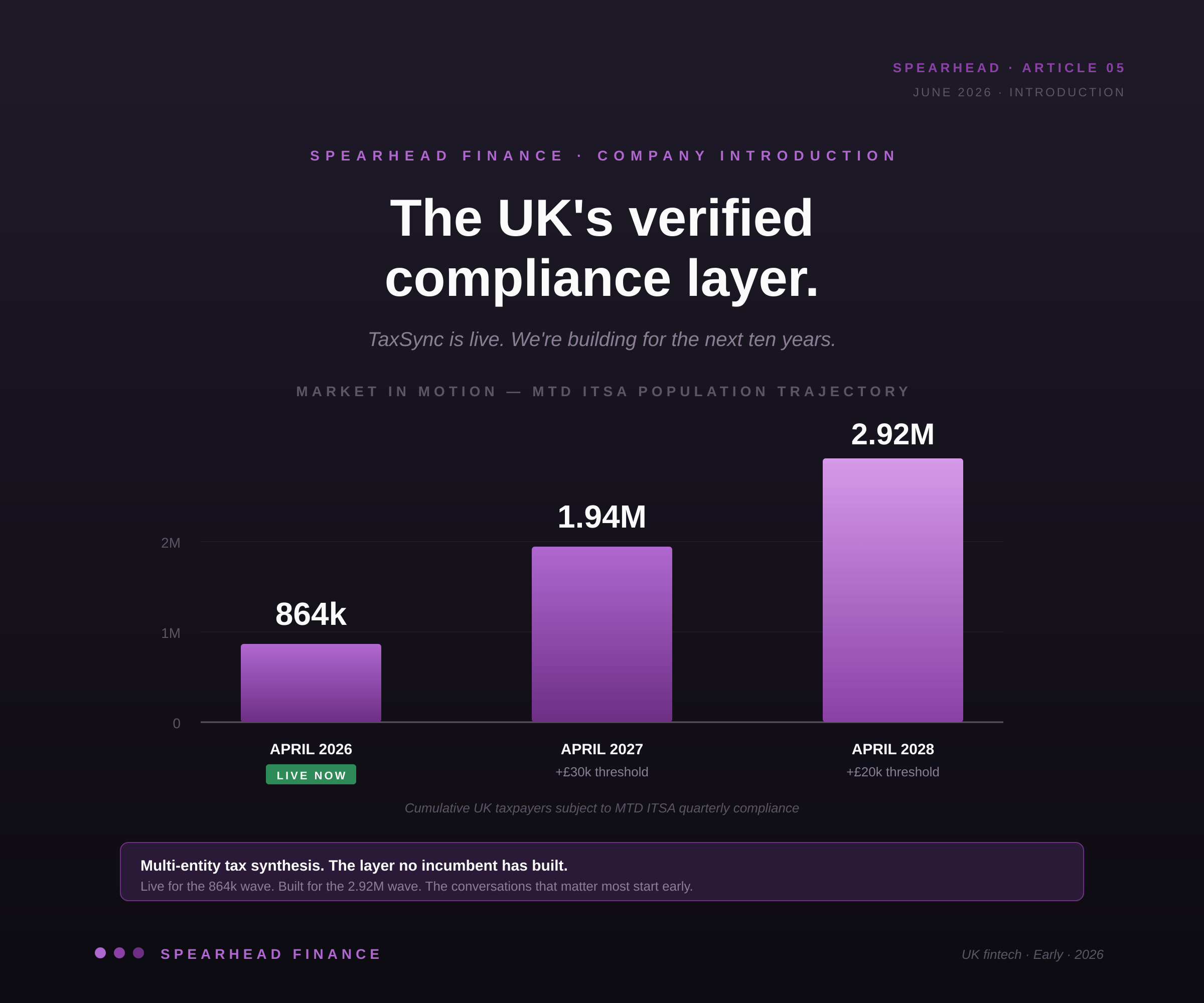
Spearhead Finance is a UK fintech holding company building the verified compliance layer for British SMEs. Our first product, TaxSync, is live for the 864,000 UK taxpayers now subject to MTD ITSA — on the path to the 2.92 million subject to it by April 2028. This article is a public introduction to what we're building. It's written for investors who might want to stay close to this space, operators who might want to join when the time is right, partners who might want to collaborate, and anyone interested in how UK fintech and accountancy are about to change. We're not actively raising right now. That decision is deliberate. The wedge product is live, the partner channel is converting, and the next twelve months are about building load-bearing depth rather than chasing a fundraising round. When we do raise, we'd prefer to do it from a position of choice — having relationships in place, having investors who understand the long arc, having the kind of conversations that start months before a round opens rather than the day a deck gets shared. This article is the start of those conversations. The framing in three sentences: MTD ITSA is mandating digital tax compliance for 2.92 million UK taxpayers by April 2028. TaxSync is the synthesis layer those taxpayers and their accountants need. The data asset TaxSync produces — the Verified Compliance Graph — is what makes Spearhead a platform company rather than a tax software company. That last sentence is the one worth holding while reading the rest. Why now: three forces converging on one market opening Three concurrent forces make 2026 the structural moment for what we're building. First: MTD ITSA. On 6 April 2026, HMRC's Making Tax Digital for Income Tax Self Assessment regime went live for 864,000 UK taxpayers with personal income above £50,000. In April 2027, the threshold drops to £30,000, adding approximately 1.08 million taxpayers. In April 2028, it drops to £20,000, adding another 970,000. By April 2028, the cumulative population subject to quarterly digital tax compliance is approximately 2.92 million. That figure is not a forecast. It is a regulatory mandate with the dates fixed in primary legislation. The 2.92 million people are about to need software that does what no incumbent has built — multi-entity tax synthesis, the work that lives between bookkeeping platforms and production tax software. There is no question about whether the demand exists; the regulatory architecture creates it. Second: the agentic shift in compliance. In March 2026, Anthropic and Xero announced JAX — agentic compliance built into Xero's bookkeeping product. Two months later, the integration shipped to 4.5 million subscribers. The market consensus is now clear: AI-native compliance is no longer optional, and traditional rule-based tax tools will be retrofitted or displaced over the next three years. The architectural question is who operates the supervised autonomy layer above the agents. TaxSync's answer — four Authority Levels with calibrated confidence thresholds, Ed25519-signed submissions, hash-chained audit trail — is documented in our engineering content. The technical depth is part of why we have the credibility we have with senior practice partners. Third: the per-seat-to-per-client transition in accountancy software. The pricing model that has sustained TaxCalc, IRIS Elements, and BrightTax for thirty years is breaking under MTD ITSA's quarterly cycle. A new commercial model — per-client wholesale — has emerged as the structural response. TaxSync's Practice Tier is purpose-built for this moment. Three forces, converging on one market opening. The companies that read this correctly and execute against it will define the next decade of UK fintech infrastructure. We intend to be one of them. What TaxSync is and does TaxSync is the multi-entity tax-position synthesis layer for UK beneficial owners. It sits architecturally above the bookkeeping platforms (Xero, QuickBooks, FreeAgent, Sage, Coconut) and alongside the production tax software (TaxCalc, IRIS Elements, BrightTax, Capium, Nomi). It does the work that lives in the gap between them — the multi-entity reconciliation that becomes acute under MTD ITSA's quarterly cycle. The product has three structural moats: The multi-entity beneficial-owner data model. No incumbent holds the tax position of a single human across their personal Self Assessment, their trading limited company, their dividends, their IR35 deemed payments, and their property SPV as a single integrated record. TaxSync does. The data model is purpose-built for how real multi-entity taxpayers exist — the typical professional contractor with five tax records, the SME founder with a trading Ltd plus a property holding company, the buy-to-let landlord with multiple SPVs. Bookkeeping platforms hold per-entity data. Production tax software holds per-return data. TaxSync holds per-person data, resolved across the entities that person controls. The Practice Tier wholesale commercial model. TaxSync sells to UK accountancy practices on a per-client wholesale basis — £15–£25 per client per month, sliding by book size, with a 12-month commitment and £150 monthly minimum. The wholesale rate embeds inside the practice's existing fixed-fee client relationship. Practices keep client pricing stable; the wholesale rate replaces the multi-entity reconciliation labour that the per-seat tax software market doesn't cover. The commercial model decouples software cost from professional headcount and aligns vendor revenue with practice growth. Supervised autonomy with cryptographic audit chain. Four Authority Levels (Read at confidence threshold 0, Recommend at 0.65, Prepare at 0.85, Submit-with-human at 0.95+). Every quarterly submission is Ed25519-signed and SHA-256 hash-chained. Practices supervise; the system handles the volume; the audit trail makes the supervision verifiable to HMRC. This is the architectural answer to the agentic-compliance question that JAX raised. The short version: TaxSync is the supervisor layer for AI-native compliance. Unit economics: B2C ARPU £75–£125/month at the multi-entity tiers (Plus and Pro), B2B Practice Tier averaging £600–£1,500 per month per practice. Gross margins above 80% at scale. Net retention is structurally strong because compliance is sticky — switching multi-entity tax records mid-year creates more work than it saves. Practice Tier as the distribution engine The Practice Tier is more than a B2B revenue line. It is the structural distribution channel for everything Spearhead builds. Every UK SME with multi-entity affairs has an accountant. The accountant is the trusted advisor on financial decisions, compliance, structuring, and (over time) financial product recommendations. By embedding TaxSync inside the practice's existing client relationship, Spearhead acquires distribution to the practice's entire book in one commercial transaction. The model is wholesale, not direct. The practice sees the wholesale rate (£15–£25/client/month). The end client sees their unchanged fixed fee. The vendor's revenue scales with the practice's book size. Acquisition cost is borne by the wholesale conversation, not by client-by-client marketing. Retention is anchored to the 12-month commitment and the structural difficulty of switching synthesis layers mid-year. The unit economics of practice acquisition: a fully-converted Practice Tier practice with 30 multi-entity clients generates approximately £6,000–£9,000 ARR. Acquisition cost (sales time + event presence + content marketing share) is roughly £1,500–£3,000. Payback in months 4–7. LTV at a 60-month assumption: £30,000–£45,000. The current state of the GTM engine, as of mid-2026: a partner pipeline that's converting; B2C signups building monthly across Standard, Plus, and Pro tiers; the first quarterly cycle completed with structural learnings embedded into the product; the AccountingWEB × Zoho Connected Practice Summit in Birmingham (16 July 2026) as a major partner activation moment. Conversion velocity accelerates substantially when the £30k MTD ITSA wave hits in April 2027. The work being done now is foundation-building — partner relationships, content authority, product depth — that compounds when the larger demographic wave arrives. The accountant partner network is the durable distribution asset that makes Spearhead a structurally different kind of company from a B2C-only tax software vendor. The Verified Compliance Graph Here is the part of the strategy worth slowing down to read carefully. Self-reported financial data is plentiful. Bank statements, accounting records, P&L exports, balance sheets — bookkeeping platforms hold this for tens of millions of UK SMEs, and the data is high-quality. But it is self-reported. The accuracy is the user's responsibility. The financial services products that try to use it apply their own verification overhead because they cannot trust self-reported data on its own. HMRC-verified compliance data is structurally different. When TaxSync submits a quarterly update to HMRC and HMRC accepts it, the data inside that submission has crossed a threshold that self-reported data has not crossed. It has been declared by the taxpayer under penalty of inaccuracy. It has been accepted by the government. It is part of the official record. Six months later, when the same data is reconciled into the final declaration, it has crossed the threshold again. The Verified Compliance Graph is the data structure TaxSync generates as a byproduct of doing its actual job. It includes: Multi-entity beneficial ownership (who owns what, in what percentages, with what voting and economic rights, across personal-name and corporate-name holdings) Cross-entity transaction flows (Ltd → personal, SPV → owner, dividends declared and received, intercompany positions, IR35 deemed payments) Tax position history, verified at each quarterly submission cycle, accruing over multi-year windows as the platform matures Cash flow patterns at the beneficial-owner level, not the entity level Property holdings, rental income flows, and the link to the personal tax position Director loan accounts, dividend timing decisions, and the underlying commercial logic captured through accountant collaboration No incumbent has this data structure, and the reason is architectural. Bookkeeping platforms hold per-entity data without cross-entity reconciliation. Production tax software holds per-return data without ongoing positional context. Banks hold transaction data without the entity structure. Accountants hold the integrated view in their heads or in spreadsheets — but not in queryable, machine-addressable, multi-tenant form. TaxSync produces it. As a byproduct. At scale. Verified. The Verified Compliance Graph is the strategic asset that makes Spearhead a platform company rather than a tax software company. What sits on top of it — and how that compounds over the long arc — is the conversation we have privately with people who want to engage with the strategy at depth. The public version of the article stops at the foundation. The private version starts with: "Now let me show you the architecture." The discipline of not saying everything in public is intentional. The discipline of having something specific to say in private is what makes the public version believable. Why this team, why this moment Three things make Spearhead the right team building this. Execution evidence. TaxSync is live. The product has shipped. The first quarterly cycle has been completed. The partner pipeline is converting. None of this is forecast — it is observable state. People who want to verify the execution can do so against published content, against practice partner introductions, against the product itself. We have shipped what we said we would ship. We continue to ship. Strategic discipline. This article is one example. We could have used it to lay out a multi-product roadmap with launch dates and unit-economic projections. We deliberately have not. The reason: the strategic value of the data asset compounds with the scope of who knows the full plan. Public articles educate competitors as much as they educate observers; private conversations are where the real strategy gets exchanged. People who appreciate that distinction tend to make better long-term partners than people who demand everything be public. Founder profile. Sola Samuel, founder and CEO, is a University of Birmingham Computer Science graduate currently employed full-time as a software engineer while building Spearhead Finance evenings and weekends. The capital efficiency this represents is not incidental — it has produced a fully-built MVP product, a partner network, a content library, and operational momentum on near-zero burn. The team expansion happens when the time is right; the work being done now is what makes that expansion economically and structurally sensible when it happens. What we're focused on The work over the next twelve months falls into four buckets: TaxSync scale-up. Moving from foundation product to load-bearing platform. More multi-entity features. Deeper accountant collaboration. Better quarterly cycle automation. Faster onboarding. The product matures alongside the user base. Practice Tier partner acquisition. Building the distribution moat. The current partner pipeline is converting; the next wave runs through the second half of 2026 and into the 2027 MTD ITSA threshold drop. The AccountingWEB × Zoho Connected Practice Summit in Birmingham (16 July 2026) is the first major activation; further trade events and direct partner outreach follow. The Verified Compliance Graph. Ensuring the data asset accrues with integrity. The architecture for queryable, multi-tenant, beneficial-owner-resolved data needs to be hardened as volume grows. The privacy, security, and compliance scaffolding around the graph is foundational work — easier to build at small scale, much harder to retrofit at large scale. Team formation. Identifying the senior people who'll run the platform alongside Sola when the time is right. Engineering, partnerships, sales, ops. The work over the next twelve months is feasible solo for the founder; the work over the twelve months after that isn't. We expect to raise capital in due course. We're not running a process right now. The right investor conversations often start before a round opens, and we'd rather have those conversations from a position of choice — when we know who shares our long-term view and who would help most when the time comes. Staying in touch For investors interested in this space. If the framing resonates and you'd like to stay close to what we're building, email info@spearheadfinance.space with 'Spearhead introduction' in the subject line. We share product context, roadmap detail, and strategic background with people who want to engage with the work at depth. We're not asking anyone to commit to anything; we're starting conversations that will matter when the time comes. For operators thinking about joining. Same email, with 'Founding team' in the subject. We're keeping a list of senior people whose interest is genuine and whose skills fit the work ahead. When the time comes to scale the team, that list is who we call first. For network introductions. If you know investors, operators, or potential partners who would find this interesting, the simplest path is to forward the article with a line of context. We're at the stage where the right warm introduction is worth more than ten cold inbounds. The work continues. We'd love to hear from people who want to be part of it — now, or when the time is right.