The agent will file your taxes. Who checks its work?
· SF Admin
AI can now prepare and file tax under your name — the unbuilt part isn't the automation, it's the supervisor.
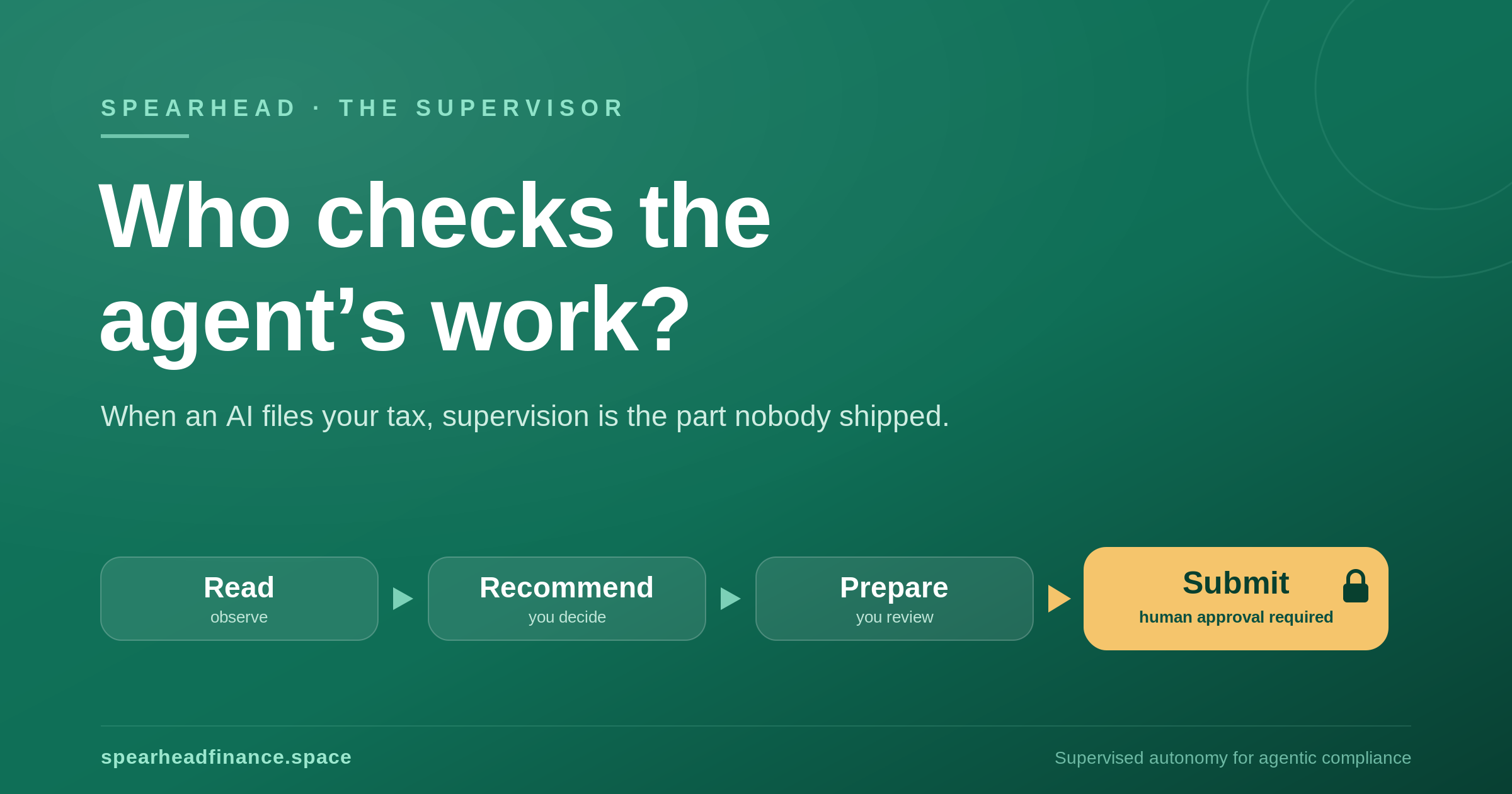
In 2026, AI stopped suggesting and started doing. That is genuinely useful — and it quietly moves a question nobody has answered: when software files under your name, who is the supervisor? Something changed in 2026 For years, "AI in accounting" meant suggestions. Your software guessed a category; you accepted it or corrected it. Helpful — but you were still doing the work. In 2026 that flipped. Xero's JAX now automates the bookkeeping itself: bank reconciliation, document capture, chasing the receipts you forgot. Its partnership with Anthropic put your live ledger inside Claude and everyday tools like Excel and Teams, so you can ask questions of your books in plain English. The books, increasingly, keep themselves. This is a real achievement, shipped to millions. We are not here to talk you out of it. The quiet leap: from "categorise this" to "file this" Notice the direction of travel. Categorising a transaction is reversible — get it wrong and you fix it next week. Filing a return to HMRC is not. It creates a legal record, a liability, and a clock. The moment an agent moves from tidying your books to preparing and submitting your tax, the stakes change entirely — even though, to you, it may feel like one more automated step. And here is the part that does not automate: you are still the taxpayer. HMRC does not accept "the AI did it" as a defence. Whatever the agent submits, it submits under your name, on your authority, with your money at the other end. The supervision question So ask the obvious thing: when an agent files under your name, who actually checks it — and how would you prove they did? The default answer, baked into most consumer products, is that you supervise yourself. The agent acts on your authorisation, the app shows you a screen, you tap approve. For a simple sole trader with one income source, that can work. But tap-to-approve is not supervision. Supervision means you — or someone acting for you — could look at a figure, understand why the agent produced it, judge whether it is right, and show that the judgement happened if HMRC ever asks. Most approve buttons give you the button without the basis for pressing it. Read → Recommend → Prepare → Submit It helps to stop treating "AI does my tax" as one thing. There is a ladder of autonomy, and each rung deserves a different level of human sign-off: Read — the agent sees your books and surfaces what it finds. No changes, no risk. Let it run. Recommend — it suggests a category or a fix; you decide. Low stakes, easily reversed. Prepare — it drafts your return. Now a human should review before anything leaves the building. Submit — it files to HMRC. Irreversible and legally binding. This rung should never turn without a deliberate, per-submission human approval — and a record of it. The mistake is letting an agent that is trustworthy at "Recommend" quietly operate at "Submit" because it is convenient. Convenience and consequence are not the same axis. What good supervision actually looks like Three things separate real supervision from a rubber stamp: Calibrated confidence. The agent should tell you when it is not sure. A tool that sounds equally confident whether it is right or wrong is worst exactly at the moment of filing; the valuable signal is "this one is uncertain — look." This is measurable, and honest tools measure it. Human approval on the irreversible steps. Anything that cannot be undone — a submission, a payment — waits for a person, every time. An audit trail of why. Not just what was filed, but the reasoning behind each figure: what the agent considered, how confident it was, who approved it. If a return is ever questioned, that trail is the difference between a five-minute answer and a bad month. Where "supervise yourself" breaks Self-supervision holds up for the simplest cases and quietly collapses on everything else. Add a second trade, a rental, a company, VAT, or costs shared across sources, and the volume and subtlety of judgement outgrows an approve screen. This is precisely the population Making Tax Digital is pulling in — people with more than one thing going on — and it is the group least served by "the taxpayer is the supervisor." For those cases, the right supervisor often is not the taxpayer alone; it is an accountant, equipped with tools that make supervising many clients' agents tractable. That is a role change worth its own article. But the principle holds: the harder the case, the more the supervision layer matters. The point None of this is an argument against automation. The agents are good and getting better, and the bookkeeping grind should be handed off. The argument is narrower, and we think more important: the industry shipped the automation and skipped the supervisor. The valuable, defensible, still-unbuilt layer is the one that decides what may be filed, under whose authority, at what confidence, and with what record — so that "the AI filed it" can be followed by "and here is exactly how we knew it was right." That layer is what we are building. TaxSync is built as the supervision layer for agentic compliance — the authority gradient, calibrated confidence, and a signed audit trail, by design. For the technical version of the argument, read our paper, "The Supervisor: An Architecture for Agentic Compliance."