The Line: when going limited actually pays (and when it quietly doesn't)
· SF Admin
"Just go limited" is the tax world's most confident bad advice. Incorporation isn't a magic profit number — it's a trade, and the only honest way to judge it is take-home versus take-home.
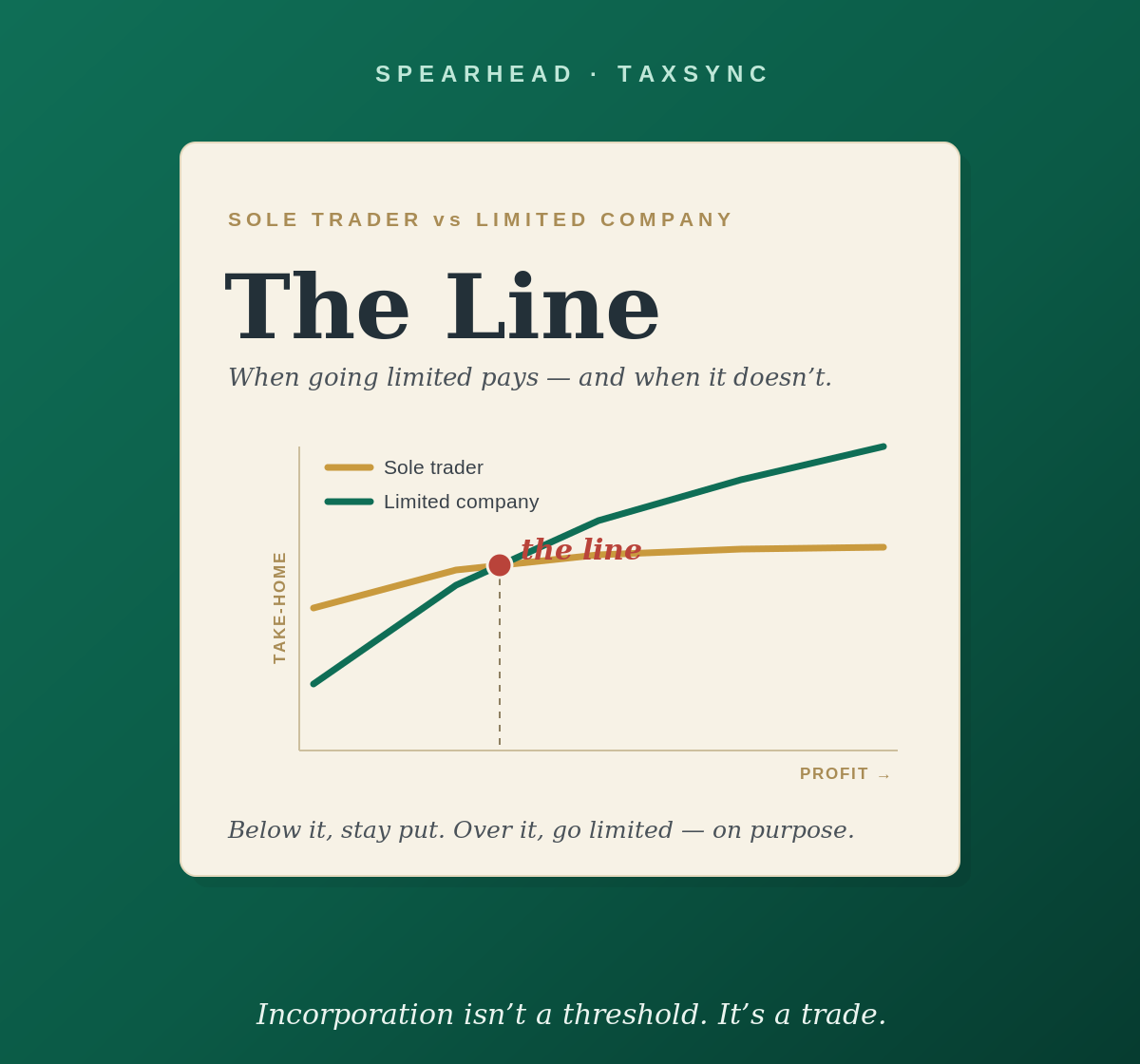
There's a moment in every growing sole trader's life when someone — a mate at a barbecue, a stranger in the quote-tweets, a YouTube thumbnail with an arrow and a shocked face — leans in and says the four magic words. "You should go limited." They say it with total confidence and no follow-up questions. Not "what do you take home?" Not "what do you want to do with the profit?" Just: go limited, as though there's a velvet rope at some exact income and you've finally earned your way past it. It's the tax world's version of "have you tried turning it off and on again." Sometimes it's exactly right. Sometimes it quietly costs you money for two years before anyone notices. And the reason it gets given so freely is that it's dressed up as a threshold, when it's actually a trade. The myth: a magic number The story everyone repeats is that incorporation switches on at a certain profit. Cross the line, save a fortune. It's tidy, it's shareable, and it's not quite true. The number that gets quoted usually comes from comparing headline tax rates — "corporation tax is 19%, higher-rate income tax is 40%, so obviously the company wins." Which sounds airtight until you remember one small detail: the company's money isn't your money. To spend it, you have to get it out of the company — as salary or dividends — and that second step is taxed too. Compare the headline rates and the company looks unbeatable. Compare what actually lands in your bank account, and the picture gets a lot more interesting. The only honest comparison: take-home vs take-home Here's the version that tells the truth. As a sole trader , it's simple: your profit is your income. You pay income tax and National Insurance on it, and what's left is yours to spend. No second step. As a limited company , the money makes two hops. First the company pays corporation tax on its profit. Then you extract what's left — usually a small salary plus dividends — and pay personal tax on the way out (dividends have their own rates, and their own small tax-free allowance). What lands in your pocket is what survives both hops. So the real question was never "which has the lower rate." It's: for my profit, after both journeys, which one leaves more in my hand? Take-home versus take-home. Everything else is a thumbnail. And when you run it that way, you find there isn't a single line — there's a band . At modest profits, the sole trader route is often a wash or even ahead once you count the costs (more on those in a second). There's a middle stretch where the company, with a sensible salary-and-dividend split, genuinely pulls ahead. And right at the top, under full extraction, the gap can narrow again. It's a hump, not a hockey stick. The costs the excitement always leaves out The barbecue advice never mentions the invoice that comes with a company. Being limited isn't free: There's more admin and more filing — annual accounts, a corporation tax return, a confirmation statement, payroll if you pay yourself a salary, the works. Most people quite reasonably pay an accountant more to handle it, and that fee is a real number that eats into the saving. There's the small matter that the money has to actually leave the company to be yours; profit left inside is the company's, not something you can spend on rent. And if you contract, there's IR35 lurking, which can rewrite the whole calculation. None of this makes incorporating wrong. It just means the honest saving is the tax difference minus the cost of being a company — and sometimes that subtraction is what turns a "yes" into a "not yet." The thing that actually decides it If you want the single question that moves the needle more than your profit does, it's this: how much of the money do you need to take out? If you live on every penny the business makes, both hops happen every year, and the advantage is whatever's left after them. If you can afford to leave some profit in the company — reinvesting, smoothing income across years, timing when you draw it — the company route gets a lot more attractive, because you defer that second hop. Two people with identical profit can land on opposite answers purely because one needs all the cash now and the other doesn't. That's why "what's the magic number" is the wrong question. Your line depends on your life, not just your invoices. Sometimes the answer is "not you, not yet" Here's the unfashionable truth: for a fair few growing sole traders, the honest answer this year is don't . The saving is too thin to survive the extra admin and accountancy. That's not a failure — it's the tool doing its job. Anything that only ever says "incorporate" isn't advising you; it's selling you a company formation. Where the line becomes yours This is the part we built. The Line is a feature inside TaxSync that stops treating incorporation as folklore and works out your answer from your forecast. It runs both routes — sole trader and limited — on your actual numbers, nets each to real take-home, subtracts the honest costs, and tells you plainly: below the line, approaching it, or over it. And because it watches your figures as you grow, it can tell you not just whether , but roughly when — "you're about £6k and a few months of growth from the point where this starts to pay." It'll also, cheerfully, tell you to stay a sole trader when that's the right call. We think that's the whole point. None of this replaces your accountant — it's the opposite. Your accountant runs exactly this comparison, properly and with all your circumstances in the room. What The Line does is let you walk into that conversation already knowing your number, so the meeting is about the decision and the timing, not about doing sums from scratch. (As ever: this is analysis, not advice — the big call is one to make with your accountant.) The takeaway "Just go limited" isn't wrong because incorporating is bad. It's wrong because it's an answer pretending there was no question. Incorporation is a trade — tax saved against costs and flexibility, judged on what actually reaches your pocket — and the moment it pays is personal to you. Find your line. Then cross it on purpose. Want to see where your line is? Try The Line in TaxSync — it works it out from your own numbers, and it'll tell you when the answer is "not yet."